EN


 Aug.24, 2026
Meal delivery businesses often lose customers for reasons that have little to do with the food itself. A leaking lid, crushed container, unstable stacking, sauce contamination, or cold food caused by poor thermal protection can turn a high-quality meal into a negative review. These failures usually originate from an unsuitable package geometry, weak sealing performance, inconsistent wall thickness, or poor compatibility between the container and delivery process. For restaurants, caterers, cloud kitchens, and food distributors, selecting a rectangular disposable plastic food container is therefore not a minor purchasing decision. It directly affects food safety, transportation efficiency, labor costs, brand reputation, and repeat orders.
At Zhengjia, we design and manufacture food packaging with these operational risks in mind. Our focus is not simply producing a container that holds food. We evaluate the complete packaging system, including resin selection, dimensional tolerance, lid engagement, stacking strength, temperature resistance, and quality control.
!
A meal delivery package must perform under pressure from preparation to final consumption. It may be filled with hot rice, oily sauces, liquid soup, fresh vegetables, or frozen ingredients before being transported through multiple handling stages.
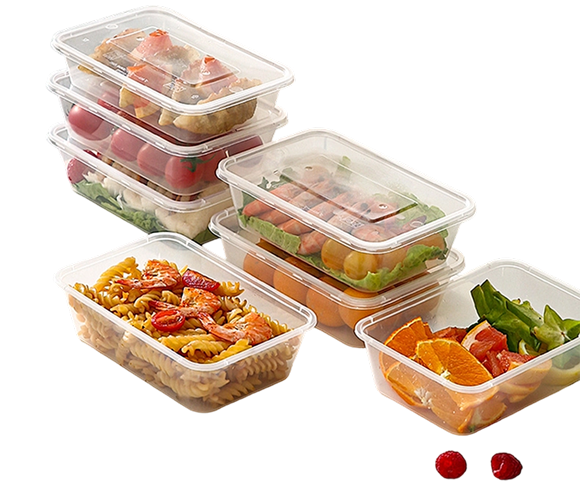
A rectangular disposable plastic food container provides several practical advantages:
The rectangular footprint also supports a more organized delivery workflow. Containers can be aligned closely, reducing movement inside insulated bags and lowering the probability of tilted lids or spilled sauces.
Round containers create unused triangular spaces when packed together. Rectangular food containers fit closely in delivery bags, shelving units, and corrugated shipping cartons.
This can help operators:
For a meal-preparation company delivering 1,000 orders per day, even a modest improvement in packing density can reduce handling time and packaging consumption across the entire operation.
The shape of a container influences how customers perceive portion size and product quality. A rectangular tray provides a broad presentation area for rice, vegetables, protein, and side dishes.
For premium prepared meals, the container can support:
A well-designed rectangular disposable plastic food container helps preserve the meal’s appearance from the production kitchen to the customer’s table.
Packaging problems are rarely caused by one factor. In most cases, they result from the interaction between material properties, container design, filling conditions, and transportation practices.
Different polymers perform differently under heat, cold, oil, and mechanical stress. Common food packaging materials include:
A container designed for chilled salads may not be suitable for hot soup. Similarly, a package that performs well at room temperature may become brittle during frozen distribution.
We recommend defining the application before selecting resin. Important parameters include:
Leakage is often caused by insufficient lid retention rather than a defective container body. A lid must engage consistently with the rim, even when the container has minor dimensional variation.
Critical design factors include:
Zhengjia uses dimensional inspection and mold-process monitoring to control critical features. For selected components, dimensional precision can be controlled to 0.01 mm, depending on the tooling structure and product specification.
Thin or uneven walls can cause:
In thermoforming and injection molding, wall-thickness distribution is influenced by mold temperature, forming pressure, material flow, cooling time, and machine settings. These variables must be controlled through process validation rather than visual inspection alone.
For foodservice companies, packaging is a cost-control tool and a customer-experience asset. A low unit price does not necessarily produce the lowest total cost.
An unsuitable package may create costs in several areas:
| Cost area | Possible business effect |
|---|---|
| Product leakage | Refunds, replacements, and customer complaints |
| Weak stacking | Damaged meals and slower order preparation |
| Poor thermal performance | Reduced food quality and lower customer satisfaction |
| Excessive packaging volume | Higher carton, storage, and freight costs |
| Unstable lid fit | More manual inspection and repacking |
| Inconsistent dimensions | Production-line interruptions |
| Weak branding surface | Lower retail and promotional value |
Suppose a delivery operator handles 10,000 meals each month and experiences a 1.5% packaging-related complaint rate. That equals approximately 150 affected orders. If each replacement, refund, and customer-service interaction costs an average of $8, the direct monthly exposure may reach $1,200 before considering lost repeat business.
Even reducing the complaint rate from 1.5% to 0.5% would prevent approximately 100 affected orders per month. The financial impact is often greater than the difference between two container unit prices.
A stable rectangular disposable plastic food container can reduce manual adjustments on a packing line. Consistent dimensions support:
For high-volume meal delivery, seconds matter. Saving only 3 seconds per order across 5,000 daily orders represents more than 4 hours of labor time each day.
We understand that buyers need more than product photographs. They need traceability, process control, and measurable quality criteria.
Our quality approach can include:
Testing requirements should be matched to the product application. Depending on the market and end use, buyers may request evaluation against relevant standards and regulations, including:
The exact test method should be confirmed according to the material, packaging structure, destination market, and customer specification. No single standard covers every meal-delivery application.
Before approving a new food container, we recommend the following sequence:
Define the food application
Identify hot, chilled, frozen, oily, acidic, liquid, or dry food conditions.
Confirm material suitability
Select PP, PET, CPET, or another approved food-contact material according to temperature and use requirements.
Review dimensions and capacity
Confirm nominal volume, usable volume, flange dimensions, and carton-packing requirements.
Test lid retention and leakage
Conduct inverted, pressure, and transport simulations where appropriate.
Evaluate thermal performance
Test the container under actual reheating, refrigeration, or freezing conditions.
Simulate distribution
Assess vibration, stacking, drop, compression, and temperature cycling.
Approve production samples
Compare mass, color, wall thickness, dimensions, and sealing behavior against the approved sample.
Monitor mass production
Use inspection records, batch identification, and nonconformity controls.
This process reduces the risk of approving a package based only on appearance.
Consider a prepared-meal operator shipping 2,000 orders per day. Its original round containers created unused space in delivery bags, and lids occasionally shifted when meals were stacked. The company recorded:
After switching to a rectangular format with a more secure rim profile, the operator could align containers more efficiently and standardize the packing sequence. In a controlled six-week internal comparison, the packaging-related complaint rate declined to 0.7%, while packing productivity increased by approximately 12%.
This example illustrates an important principle: packaging performance must be measured across the workflow. The value of a rectangular disposable plastic food container comes from its combined effect on sealing, stacking, labor, presentation, and logistics—not from shape alone.
Neglecting packaging validation can be especially damaging when business conditions change. A small restaurant may initially deliver 50 meals per day, but a successful promotion, corporate catering contract, or online marketplace listing can increase demand to 500 meals per day.
A package that seems acceptable at low volume may fail when:
The consequences may include:
Ignoring these risks can also create a false economy. Saving a few cents per unit may cost significantly more through returns, labor, product waste, and customer churn.
When evaluating Zhengjia products or requesting a customized solution, buyers should prepare clear technical information.
A qualified supplier should be able to explain:
We also encourage buyers to request samples filled with their actual food products. A container that performs well with dry rice may behave differently with hot curry, oily pasta, or liquid soup.
The answer to “Why Choose Rectangular Plastic Food Containers for Meal Delivery?” is practical: the right geometry improves space utilization, stacking stability, meal presentation, and operational consistency. When supported by suitable material selection, reliable lid engagement, dimensional control, and application-specific testing, a rectangular disposable plastic food container can reduce delivery risk and support a stronger customer experience.
At Zhengjia, we work with buyers to evaluate the complete packaging requirement rather than focusing only on unit price. By combining food-contact material knowledge, mold-process control, inspection procedures, and responsive technical support, we help meal-delivery businesses select packaging that performs under real conditions.
Before placing your next order, review your food temperature, delivery distance, stacking method, and complaint data. Then contact Zhengjia with your required dimensions, capacity, material, and application details. Choosing a validated rectangular disposable plastic food container today can protect your margins, reputation, and future growth.
We look forward toworking with you.
Feel free to reach out for any queries. We would be happy to help!