EN


 Oct.27, 2026
Choosing between square take out containers and round containers affects food portions, storage space, delivery performance, and operating cost. Buyers usually want more than a basic shape comparison. They need to know which container stacks better, holds food more securely, fits common bags and shelves, and gives customers a useful portion without excessive packaging.
This guide compares both formats through measurable parameters, practical handling, storage efficiency, leak resistance, food presentation, and suitability for different purchasing groups. Zhengjia helps food businesses evaluate container shape with a focus on reliable packaging performance and efficient daily use.

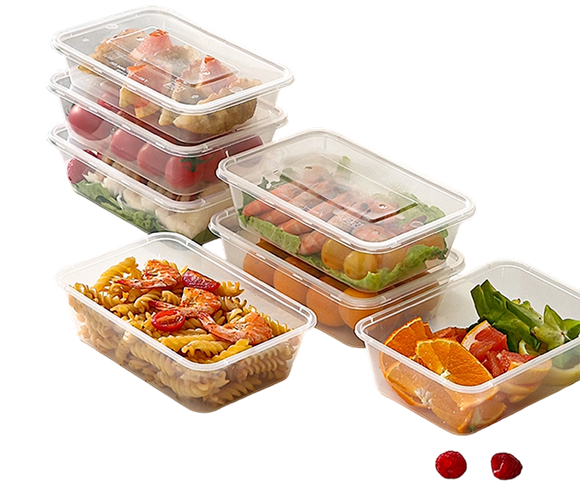
Square take out containers usually provide more usable corner-to-corner capacity in refrigerators, delivery bags, and storage shelves. Their straight sides allow multiple units to sit closely together with less unused space between containers.
Round containers leave open gaps when placed beside one another, but their curved walls make them convenient for soups, salads, noodles, and foods that need to be stirred or rotated. The best shape depends on whether the operation values storage density or flexible handling.
In practice, shape alone does not determine quality. A well-designed round container can outperform a weak square container if it has a stronger lid seal or better material consistency. Buyers should evaluate the complete package rather than choosing only by appearance.
The following comparison gives a practical starting point for purchasing teams. Exact values vary by model, so buyers should confirm the technical specification for the selected container before ordering.
| Parameter | Square take out containers | Round take out containers | Purchasing meaning |
|---|---|---|---|
| Common capacity range | 250 ml to 1500 ml | 250 ml to 1500 ml | Both formats can cover small sides, standard meals, and large portions. |
| Space efficiency | High because straight walls use corners and shelf depth efficiently | Moderate because curved walls create gaps between units | Square formats can reduce wasted storage space. |
| Stacking stability | High when bases and lids have matching stacking features | Moderate to high, depending on rim and lid design | Check whether filled containers remain stable during transport. |
| Best food types | Rice, pasta, meat, vegetables, meal combinations, dry foods | Soup, curry, noodles, salad, sauces, circular desserts | Match the shape to the food movement inside the package. |
| Corner access | Food can remain in corners during serving | Easy access around the entire interior wall | Round containers may reduce food residue during scooping. |
| Portion control | Easy to organize by length, width, and compartment layout | Easy to fill consistently by volume and visible surface level | Both work, but square formats can support meal arrangement. |
| Leak control | Requires strong corner sealing and a uniform rim | Usually has a continuous curved sealing path | Inspect the lid fit, rim pressure, and corner performance. |
| Storage footprint | Compact on shelves, in cartons, and in delivery bags | Requires more space around each unit | Square designs can improve warehouse density. |
| Microwave and freezer use | Depends on the selected material and manufacturer instructions | Depends on the selected material and manufacturer instructions | Do not assume shape determines temperature resistance. |
| Typical cleaning difficulty | Corners may retain sauce or rice | Curved walls are usually easier to rinse | Reusable systems need special attention to washing labor. |
For bulk buyers, the most important technical checks are actual filled capacity, external dimensions, lid compatibility, stack height, material grade, wall thickness, temperature tolerance, and carton quantity. Nominal volume alone does not show how much food the container can hold without pressing against the lid.
Storage is one of the strongest reasons buyers select square take out containers. Straight edges allow units to line up on shelves and inside delivery bags. This can make stock counting faster and reduce the unused gaps that appear when round containers are packed together.
Stacking performance depends on more than the shape. A container needs a stable base, a lid that does not slide easily, and consistent dimensions across the production batch. Containers that look square but have rounded or uneven bases may still shift during transport.
In actual use, square containers are often more stable when placed in rows. Round containers can be stable when the lid has a deep locking rim, but they may roll or shift if the delivery bag has unused side space. Dividers, paper sleeves, and tight bag dimensions can improve the performance of either format.
For restaurants with limited refrigerator shelving, meal preparation facilities, and high-volume delivery operations, square containers often provide the better storage result. For small businesses that carry fewer units and prioritize easy access or liquid foods, the difference may be less important.
Square containers make it easier to separate visual sections of a meal. Rice can occupy one side, vegetables another, and a protein portion can be placed in the remaining space. This arrangement can make a standard meal look organized and repeatable.
Round containers create a natural central presentation. They are useful when the customer mixes the contents, pours sauce over the meal, or eats directly from the container. The absence of corners can also make soups, curries, and noodles easier to stir.
Portion accuracy should be tested with the actual menu. Weigh a normal serving, place it in the container, and check the remaining headspace. A suitable container should leave enough room to close the lid without crushing food while avoiding excessive empty space that makes the portion appear too small.
Leakage is one of the most expensive packaging failures because it can damage the meal, delivery bag, vehicle, and customer experience. Square containers have four corner areas that require consistent sealing. Round containers have a continuous curved rim, which can simplify sealing, but a weak lid can still leak under pressure.
Practical testing should use the actual foods sold by the business. Water testing alone may not reveal how oil, steam, sauce, or food particles affect the lid seal.
During testing, check whether the lid pops open when the contents expand from heat. Steam pressure can cause problems even when a cold container passes a basic leak test. A vented lid may be appropriate for some hot foods, while a tight non-vented lid may better retain moisture for other menu items.
Round containers may be convenient for liquids, but their circular lids can be harder to label or stack in narrow bags. Square containers may offer better bag stability, but their corners need closer inspection after sealing. The best choice is the format that passes a repeated, filled transport test with the lowest failure rate.
Buyers should select the material according to the full use cycle. A container used for hot takeout, freezing, reheating, and delivery faces different stresses from a container used only for dry room-temperature food.
Actual handling experience should include lid removal, filling speed, stacking, labeling, reheating, and disposal. Staff may prefer a container that closes quickly and consistently even if another model has a slightly better appearance.
Battery life is not relevant to disposable food containers, but purchasing teams should evaluate the equivalent daily-use performance factors:
A short in-store trial with actual staff is more useful than relying only on a catalog photograph. Record filling time, rejected units, leakage incidents, storage space used, and customer complaints before committing to a large order.
| Format | Advantages | Disadvantages |
|---|---|---|
| Square take out containers |
|
|
| Round take out containers |
|
|
The decision should be based on the dominant problem in the operation. If wasted storage space and disorganized delivery bags are the main concerns, square containers are usually the stronger choice. If leakage from liquid meals and ease of stirring are the main concerns, round containers may be more practical.
Restaurants, caterers, meal preparation companies, food manufacturers, and household buyers do not use containers in the same way. The correct recommendation changes according to volume, menu, delivery distance, and storage conditions.
Purchasing groups should also consider order volume and replacement speed. A container that performs well but is difficult to restock can create operational risk. Confirm minimum order quantity, carton dimensions, lead time, lid availability, and consistency between production batches.
Before approving a product, purchasing teams can use the following evaluation process. It combines technical review with actual use experience and helps compare square and round containers fairly.
A simple scoring sheet can assign a rating from one to five for capacity accuracy, storage efficiency, stacking stability, leak resistance, food presentation, staff handling, and total cost. Use the same test conditions for both shapes. This avoids selecting a container based only on a low unit price or attractive product photograph.
For many delivery-focused operations, the most balanced solution is not choosing one shape exclusively. Square containers can handle dry meals and meal combinations, while round containers can handle soup, curry, and other liquid dishes. A two-format packaging system may reduce food damage and improve customer satisfaction more effectively than forcing every menu item into one container style.
Square take out containers are often the stronger option for businesses that need compact storage, stable stacking, repeatable meal portions, and organized delivery. Their main drawbacks are corner cleaning, corner sealing, and the possibility of food residue in difficult-to-reach areas.
Round containers are often the stronger option for businesses that serve soups, curries, noodles, salads, and foods that customers mix or eat directly from the package. Their main drawbacks are lower storage density, greater movement in loose delivery bags, and less efficient use of rectangular shelf space.
The final decision should consider:
Zhengjia can help purchasing teams compare square and round packaging according to the actual menu, storage system, and delivery process. When the container shape, material, lid design, and portion size work together, the result is safer transport, better storage control, and a more consistent customer experience.
We look forward toworking with you.
Feel free to reach out for any queries. We would be happy to help!