


Choosing the right container is less about appearance than usable volume, lid fit, transport stability, and the food’s temperature. This rectangular disposable food containers size guide helps restaurants, meal-prep businesses, caterers, food manufacturers, and households select the best rectangular disposable container for meal prep, including rectangular takeout containers with compartments. The key concepts are nominal volume, headspace, and flexural modulus. Together with microwave-safe polypropylene containers, leak-resistant food packaging, and food portion control, these criteria solve common problems such as crushed lids, sauce leakage, underfilled packages, and meals that do not fit after cooking.
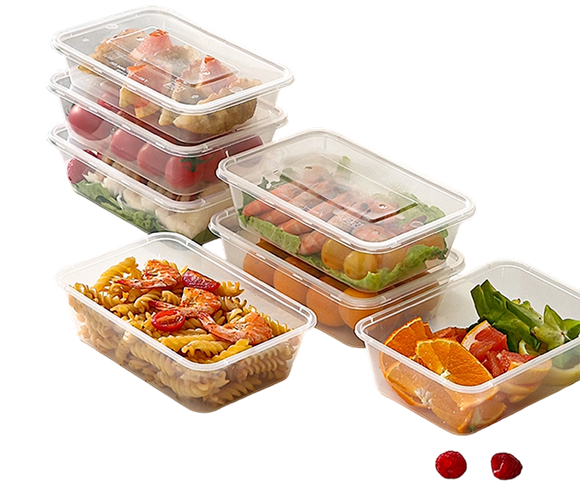
Why Rectangular Disposable Plastic Food Container Size Matters
A container marked “500 ml” does not always hold 500 ml of usable food. Manufacturers typically describe nominal volume, measured under a defined filling condition. The practical capacity is lower because food needs clearance below the lid. A useful working rule is to reserve 8–15% of the internal volume as headspace. For liquid or saucy foods, 15–20% is safer, particularly when the package will be carried, stacked, or heated.
For example, a 500 ml container filled with 450 ml of soup leaves only 10% headspace. That may be adequate when the soup is cold and transported upright, but it creates a higher spill risk if the container is tilted. A 650 ml model filled with the same 450 ml leaves approximately 31% headspace, improving lid clearance but increasing empty packaging volume. The correct choice depends on both the food portion and the transport route.
Rectangular Disposable Food Container Capacity and Usable Fill
Use this formula before ordering:
Recommended nominal capacity = target food volume ÷ target fill ratio
If the target meal is 420 ml and the desired fill ratio is 85%, the calculation is 420 ÷ 0.85 = 494 ml. In practice, a 500 ml container is the closest standard size. If the meal contains gravy, oil, or foods that expand during heating, a 650 ml container may provide better headspace.
Weight also matters. Cooked rice has a typical bulk density of approximately 0.75–0.85 g/ml, while dense foods such as cooked beans may approach 0.85–0.95 g/ml. A 500 ml container therefore may hold about 375–475 g of rice or beans, depending on moisture content and packing pressure. Food weight should be tested with an actual production portion rather than estimated from volume alone.
Rectangular Disposable Plastic Food Container Materials and Performance
The material determines temperature resistance, rigidity, clarity, seal behavior, and disposal requirements. Common options include polypropylene, polyethylene terephthalate, polystyrene, and fiber-based materials with coatings. For hot meals and reheating, polypropylene is often selected because its melting range is commonly around 160–170°C, although the safe operating range of a finished container is lower and must be confirmed by the supplier’s technical specification.
Polypropylene Rectangular Disposable Food Containers
Polypropylene, often identified by resin code 5, offers a useful balance of impact resistance, low density, and heat tolerance. A typical polypropylene density is about 0.90–0.91 g/cm³. Its flexural modulus commonly falls in the approximate range of 1,000–1,600 MPa, depending on grade, additives, wall thickness, and processing. A higher flexural modulus generally improves resistance to bending, but geometry and rim design also strongly affect stacking strength.
These containers are suitable for rice dishes, pasta, curries, roasted vegetables, and many chilled or frozen meal applications. They may be suitable for microwave reheating when specifically labeled for that use. Remove or loosen the lid during microwave heating unless the lid is designed with a vent. A sealed container can build pressure as water vapor expands, increasing the possibility of lid release or deformation.
Clear PET Rectangular Disposable Food Containers
PET provides high transparency and a smooth surface that displays salads, fruit, desserts, and chilled prepared foods effectively. Its heat performance is generally lower than polypropylene, so it is usually better suited to cold or room-temperature products. PET is not automatically appropriate for microwave use merely because it is food-contact grade. Confirm the temperature range and intended application on the product specification.
Rectangular Food Containers with Fiber or Coated Paperboard
Fiber-based containers can reduce plastic content, but their performance depends on the coating, seam construction, liquid exposure time, and disposal system. A greasy meal or watery sauce can weaken an uncoated paperboard structure. For long delivery routes, test the container after 30, 60, and 90 minutes of contact with the actual food. Compostability claims should be matched to the certification and waste-processing conditions available in the target market.
Rectangular Disposable Food Container Size Chart by Use Case
The following ranges are practical starting points. Dimensions vary by mold, wall thickness, rim profile, and whether the listed capacity is nominal or usable.
| Nominal capacity | Typical food application | Suggested usable fill | Important selection note |
|---|---|---|---|
| 250–350 ml | Desserts, fruit, side dishes, snacks | 210–300 ml | Choose a shallow profile for easy access and presentation. |
| 400–500 ml | Light lunches, salads, noodles, single side meals | 340–425 ml | Suitable for controlled portions with limited sauce. |
| 600–750 ml | Standard rice meals, pasta, curries, mixed entrées | 510–640 ml | A strong general-purpose range for takeaway meals. |
| 900–1,000 ml | Large meals, family portions, meal combinations | 765–850 ml | Check stack height and delivery-bag compatibility. |
| 1,200–1,500 ml | Family meals, bulk preparation, catering | 1,020–1,275 ml | Use a reinforced rim and a lid with reliable locking force. |
Capacity alone is not enough. A 750 ml container with a wide base may hold a flat schnitzel or layered salad more effectively than a taller 750 ml container. For foods with a large footprint, compare the internal length and width with the food dimensions. Leave at least 5–10 mm around rigid food items to prevent pressure on the lid and sidewalls.
How to Choose Rectangular Disposable Plastic Food Container Dimensions
The selection process becomes more reliable when the container is treated as part of the entire packaging system rather than as an isolated item.
Step 1: Measure the Real Portion for a Rectangular Disposable Food Container
Prepare the meal using the same recipe and cooking method used in production. Weigh the finished portion, then measure its volume where relevant. Record both values because food density changes during cooking. For a meal containing rice, protein, vegetables, and sauce, measure each component separately before combining them.
A 400 g meal may occupy 480 ml when loosely packed but only 410 ml when compressed. Compression can damage delicate foods and can push sauce toward the lid. The test should reflect the serving method used by staff, not an idealized laboratory fill.
Step 2: Match Internal Footprint to Food Shape
Measure the longest and widest parts of the food. Select an internal container length at least 10 mm greater than the longest item and an internal width at least 5–10 mm greater than the widest item. For layered dishes, compare internal height after allowing room for lid clearance.
For example, if a sandwich is 170 mm long, 75 mm wide, and 45 mm high, a container with an internal base close to 180 × 85 mm and usable height above 50 mm is more practical than a deeper container with a narrow base. This reduces sliding and preserves presentation during delivery.
Step 3: Calculate Headspace for Sauces and Expansion
Reserve approximately 15% headspace for soups, gravies, and meals that will be reheated. For dry foods that remain upright, 8–10% may be sufficient. If the food is packed hot, account for steam release and condensation. A vented lid can reduce pressure accumulation, but it will not prevent leakage if the container is tilted.
Do not fill a container to the rim simply because the food technically fits. A lid may require 3–8 mm of clearance, depending on its underside ribs and seal channel. Food touching the lid can contaminate the sealing surface and reduce closure reliability.
Step 4: Select a Lid and Check Closure Force
A good lid must match the rim geometry. Flat lids are efficient for stacking, while raised lids provide extra clearance for salads, fried foods, and garnishes. Hinged lids improve service speed, but separate lids may provide stronger rim engagement for high-volume packing.
Conduct a simple closure test with at least 30 filled samples. Record whether each lid is fully engaged at all corners. For liquid meals, invert 10 samples for 30 seconds, then place them on their sides for 5 minutes. A failure rate above 0% in a commercial delivery application should trigger a review of the lid, rim, fill level, and sealing surface.
Step 5: Test Temperature and Reheating Conditions
Measure the actual food temperature at filling and after reheating. A container labeled for hot food should be tested with the real meal, not only with water. Examine warping, odor transfer, discoloration, softening, lid release, and sauce leakage.
For microwave use, test a representative sample at the intended power level and time. For example, test 700–900 W reheating for 2–3 minutes if that reflects customer instructions. Do not assume that a container rated for hot filling is also suitable for microwave use. Hot-fill resistance and microwave performance are separate validation requirements.
Step 6: Test Stacking and Delivery Conditions
Stack filled containers in the same configuration used in delivery. Place the stack in the actual bag or carton and simulate a route with turns, stops, and vibration. Check the bottom container after 30–60 minutes for buckling, lid distortion, and food migration.
Stacking performance depends on wall thickness, corner radius, ribs, base design, and load distribution. A tall 1,000 ml container may hold the required volume but create a taller, less stable delivery stack than two lower 500 ml containers. The lower option may also improve temperature separation and portion flexibility.
Rectangular Disposable Food Containers with Compartments
Compartment containers solve portion separation problems, but dividers reduce usable capacity. A nominal 750 ml three-compartment tray may provide only 600–680 ml of practical food space because the divider walls occupy volume and each section needs its own headspace.
Use the largest compartment for the main starch or protein, the medium compartment for vegetables, and the smallest compartment for sauce, fruit, or garnish. If the sauce is watery, a taller divider or separate sauce cup may be more reliable than a shallow partition. Oil migration is another concern: fried foods can lose crispness when placed next to wet vegetables in a closed container.
When to Choose Separate Rectangular Disposable Containers
Choose separate containers when portions vary substantially, when foods require different temperatures, or when a sauce must remain isolated. Two 500 ml containers can provide more operational flexibility than one 1,000 ml container, although they increase lid use, labeling time, and packaging cost.
For meal-prep operations, compare the total packaging weight and storage volume. If one 1,000 ml container weighs 28 g and two 500 ml containers weigh 18 g each, the split format uses 36 g of plastic per meal set, an increase of 8 g or approximately 28.6%. That increase may be justified when it reduces leakage, improves portion control, or allows customers to reheat components separately.
Advanced Rectangular Disposable Plastic Food Container Selection
Use Food Density Instead of Volume Alone
Two meals with the same volume can impose different loads on the container. A 700 ml meal of rice and chicken may weigh 500 g, while a 700 ml salad may weigh 250 g. The heavier meal creates more compressive stress on the lower containers in a stack. For high-density food, favor a stronger base, reinforced corners, and a lid designed for vertical load transfer.
Consider Moisture and Gas Barrier Requirements
Fresh produce releases moisture through respiration, while hot food releases vapor during cooling. Excess condensation can soften fried coatings and accelerate quality loss. Packaging performance can be evaluated through water vapor transmission rate and oxygen transmission rate, although the final result also depends on lid venting, food temperature, storage duration, and headspace.
For chilled salads, a vented or slightly breathable design may protect texture better than an airtight container. For sauces and aromatic foods, a tight rim seal is more important. The correct balance should be determined through a shelf-life or transport trial using the actual product.
Optimize Carton and Storage Efficiency
Measure the outside length, width, and height rather than relying only on nominal capacity. A container with outside dimensions of 190 × 140 × 50 mm may fit 12 units in a carton arrangement that wastes less space than a 200 × 130 × 55 mm model, even if both are marketed as 750 ml. Calculate:
Carton utilization = packed container volume ÷ carton internal volume × 100%
Improving carton utilization from 72% to 84% can reduce empty transport space by approximately 14.3% for the same number of units. Always confirm that nesting does not cause containers to lock together or become difficult for staff to separate.
Common Rectangular Disposable Food Container Mistakes
- Buying by capacity only: The stated milliliters may not reflect usable volume, internal footprint, or headspace.
- Ignoring the lid: A container and lid from different mold systems may appear compatible but fail at the rim.
- Testing with water only: Water does not reproduce oil, starch, steam, food particles, or thermal expansion.
- Overfilling: Food touching the lid can contaminate the sealing channel and cause leakage.
- Using PET for reheating without validation: Clear appearance does not indicate microwave suitability.
- Choosing the deepest model: Excessive depth can make food difficult to access and increase tipping risk.
- Skipping transport simulation: A container that passes a stationary leak test may fail after vibration and tilting.
How Zhengjia Supports Rectangular Disposable Food Container Sourcing
Zhengjia can help buyers compare rectangular disposable plastic food containers by capacity, internal dimensions, material, lid style, compartment layout, and application temperature. Before placing a bulk order, request samples and record the container’s external dimensions, internal base dimensions, weight, nominal capacity, usable fill, lid compatibility, and packaging quantity.
A practical sample approval sheet should include at least 30 units for closure testing, 10 units for leak testing, and several units for hot-fill or reheating evaluation. Record the food type, fill weight, fill temperature, heating time, storage duration, and transport simulation conditions. This creates a repeatable basis for comparing suppliers rather than selecting on price alone.
Final Checklist for Rectangular Disposable Food Container Size Selection
- Define the target portion by both grams and milliliters.
- Measure the food’s length, width, height, and density after cooking.
- Select a nominal capacity that leaves 8–15% headspace, or up to 20% for liquid food.
- Check internal dimensions rather than depending on the capacity label.
- Match polypropylene, PET, or fiber construction to the temperature and storage requirement.
- Confirm lid and rim compatibility with filled samples.
- Test leakage, stacking, reheating, condensation, and transport vibration.
- Compare packaging weight, carton utilization, and total cost per served portion.
The most reliable rectangular disposable food containers size guide is built around the actual meal, not a generic capacity chart. Select the best rectangular disposable container for meal prep by balancing nominal volume, usable fill, headspace, food density, and lid performance. For rectangular takeout containers with compartments, evaluate each section separately and confirm that microwave-safe polypropylene containers, leak-resistant food packaging, and food portion control match the intended use. Zhengjia can be contacted for product recommendations, sample evaluation, and customized rectangular disposable plastic food container solutions based on your dimensions, temperature range, and delivery conditions.


