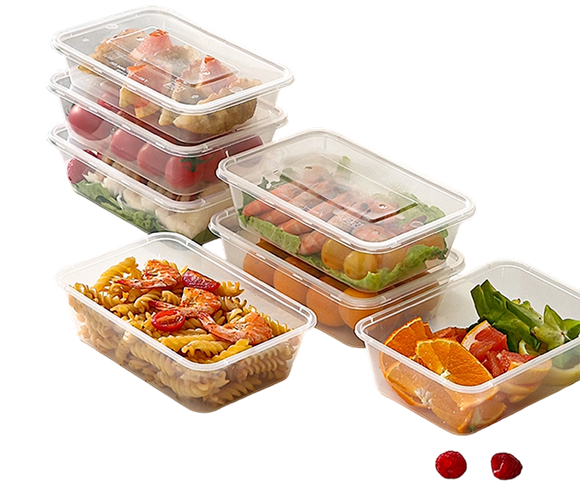
Choosing between a pp round container for takeaway food, a rectangular PP food container with lid, and the best takeaway container for rice and curry affects portion control, delivery stability, storage space, and customer satisfaction. Restaurants also compare microwave-safe food packaging, leak-resistant meal prep containers, and food-grade polypropylene while checking polypropylene (PP), thermal resistance, and oxygen transmission rate. A round box may protect saucy dishes from corner leakage, whereas a rectangular box may use delivery bags and refrigerator shelves more efficiently.

Why the PP Round Container vs Rectangular Container Decision Matters
A takeaway operator rarely chooses packaging for appearance alone. The shape influences how much food can be packed, how the lid seals after filling, whether containers tip during delivery, and how much unused air occupies a delivery bag. The wrong format can create practical problems: curry collects in corners, noodles slide during transport, lids buckle under stacking pressure, or containers consume more shelf space than expected.
For example, a meal-preparation kitchen may fill 500 ml containers with rice, vegetables, and protein. If the boxes are stored in a refrigerator in rows, rectangular units generally create fewer gaps. A restaurant selling soup, curry, or circular desserts may prefer a round box because its continuous rim can provide consistent sealing pressure around the lid. Neither shape is automatically superior; the correct choice depends on food viscosity, portion geometry, transport time, and storage workflow.
PP Round Container and Rectangular Container Parameter Comparison
The following comparison uses common commercial specifications. Exact results vary according to resin grade, wall thickness, lid design, molding process, and supplier quality-control standards. Buyers should request a technical data sheet and conduct a filled-container drop and leakage test before placing a large order.
| Evaluation factor | PP round container | Rectangular PP container | Operational meaning |
|---|---|---|---|
| Common capacities | 250–1,000 ml; larger sizes are available | 350–1,500 ml; multi-compartment models are common | Rectangular formats offer more options for complete meals and meal prep. |
| Typical footprint | Approximately 110–180 mm diameter | Approximately 130 × 100 mm to 220 × 160 mm | Round containers may leave triangular gaps in cartons; rectangular units pack in rows. |
| Seal geometry | Continuous circular rim with no corners | Four corners require accurate lid and rim alignment | Round rims can simplify sealing; rectangular designs need stronger corner control. |
| Stacking efficiency | Good when matched to a round dispenser or cup carrier | Generally higher in delivery bags, refrigerators, and cartons | Rectangular shapes usually reduce unused storage volume. |
| Compartment availability | Limited, although divided inserts exist | One, two, or three compartments are widely available | Rectangular packaging is convenient for rice, protein, vegetables, and sauce separation. |
| Approximate empty weight | 10–35 g for many 250–1,000 ml formats | 15–45 g for many 350–1,500 ml formats | Weight depends more on capacity and wall thickness than on shape alone. |
| Microwave suitability | Often suitable when made from microwave-rated PP | Often suitable when made from microwave-rated PP | The microwave symbol and supplier instructions matter more than the shape. |
| Leakage risk | Lower corner-related risk for liquid foods when the lid is properly fitted | Reliable with a designed locking rim, but corners can become stress points | Seal performance must be measured with the actual food and filling temperature. |
| Indicative wholesale price | About US$0.05–US$0.18 per set in high-volume orders | About US$0.07–US$0.25 per set in high-volume orders | Tooling, lid type, printing, order volume, freight, and resin prices can change the total. |
In food packaging, “PP” refers to polypropylene, a thermoplastic polymer commonly selected for its balance of stiffness, chemical resistance, and heat performance. Many food-grade PP products tolerate reheating temperatures around 100–120°C, but this is not a universal specification. A container should only be marketed as microwave-safe when the finished product has been tested and labeled for that use.
How PP Round Containers Perform With Different Takeaway Foods
PP round containers for soup, curry, and sauced dishes
Round containers work well when the food is fluid or semi-fluid. Soup, curry, stew, porridge, congee, and fruit salad move around the container during transport. The circular wall has no internal corners where sauce can accumulate, and the lid’s sealing path remains continuous around the entire circumference. This does not eliminate leakage: an overfilled container, a warped lid, or a weak snap fit can still fail.
A practical filling rule is to leave headspace rather than filling to the rim. For hot liquids, a food-service operator may test 8–12% free volume, then check whether thermal expansion and pressure changes affect the lid. The exact percentage should be confirmed with the actual recipe, temperature, and container design. A 750 ml round box filled with 650–680 ml of curry may transport more reliably than the same box filled to its nominal maximum.
Rectangular PP containers for rice, noodles, and complete meals
Rectangular containers are usually more efficient for foods arranged in sections. Rice, grilled chicken, vegetables, sushi rolls, noodles, and meal-prep combinations fit naturally into a long or square footprint. A three-compartment container can keep sauces away from fried food, reducing moisture migration and preserving texture for longer delivery routes.
Rectangular walls also make portion presentation easier. A caterer can place the protein in one corner, starch in the larger section, and vegetables along the side. This arrangement helps staff repeat the same portion without weighing every component. However, the corners need attention. If the lid is not fully engaged at all four corners, a small pressure point may become a leakage path during a motorcycle delivery.
Storage, Delivery, and Restaurant Workflow Comparison
The decision becomes clearer when the complete workflow is followed from cooking to customer use. A round container may be filled quickly from a ladle, while a rectangular container may be faster for assembly-line portioning. A round unit can fit well in cup-style carriers, but rectangular units generally use the available area of a paper bag more efficiently.
Consider a delivery bag measuring approximately 300 × 250 mm at its usable base. Four rectangular containers measuring about 140 × 100 mm can often be arranged with less unused area than four round containers with a 140 mm diameter. The actual result depends on lid height, bag insulation, and stacking rules, but the rectangular footprint can reduce lateral movement and improve carton utilization.
In a refrigerator, rectangular packaging also allows closer side-by-side placement. Fewer gaps can mean more usable shelf capacity, although airflow must not be blocked when cooling freshly cooked food. Food safety depends on the cooling procedure, not simply on container shape. Hot food should be cooled and stored according to the operator’s local food-safety requirements, with time and temperature recorded where required.
Price Analysis: PP Round Container vs Rectangular Container
Unit price is only one part of packaging cost. A cheaper container can become more expensive if it requires larger bags, extra sauce cups, more protective inserts, or more frequent replacements after leakage complaints.
For a simple cost model, assume a round container set costs US$0.10, while a rectangular set costs US$0.12. At 1,000 meals per week, the direct weekly difference is US$20. If the rectangular box reduces delivery-bag usage by US$0.03 per meal, its packaging system saves approximately US$30 per week despite the higher unit price. Conversely, if round containers reduce sauce leakage and prevent 10 refunds of US$8 each, the round format may provide the stronger financial result.
Ask the supplier to separate the following cost items:
- Container and lid unit price
- Minimum order quantity
- Tooling or mold charges
- Printing and labeling fees
- Sample and testing costs
- Carton dimensions and freight charge
- Replacement policy for damaged or mismatched lids
Zhengjia can be considered when a buyer needs several capacities or private-label packaging, but the purchasing team should compare wall thickness, lid fit, food-contact documentation, and delivered cost rather than choosing a supplier solely by catalog price.
Real-World User Case: A Small Curry and Rice Takeaway Trial
One useful way to evaluate the formats is to track a real operating trial instead of relying on product photographs. In a four-week comparison conducted by a small curry-and-rice takeaway operator, the kitchen tested 650 ml round containers for curry meals and 700 ml rectangular containers for rice-based meals. The team recorded 120 deliveries for each format, using the same motorcycle delivery area and similar filling temperatures.
The round format recorded three customer-reported leaks, equal to 2.5% of deliveries. Two occurred after the containers had been overfilled, and one was linked to a lid that had not been pressed fully around the rim. The rectangular format recorded five leaks, or 4.2%. Four involved corner sections where the lid was not completely locked. However, the rectangular containers reduced average packing time from 42 seconds to 35 seconds per meal because staff could place rice, protein, and vegetables in fixed positions.
The same operator also found that 24 rectangular containers occupied approximately 18% less shelf footprint than 24 round containers when arranged in the existing delivery carton. The round boxes were retained for curry and dal, while the rectangular boxes became the standard for dry rice meals. This case does not prove that one shape always wins; it shows why menu-specific testing produces a better decision than a general preference.
What Users Commonly Say About Round and Rectangular Food Containers
Customer feedback tends to follow recognizable patterns. Users of round containers often mention easier stirring, fewer sauce pockets, and a lower perception of leakage around corners. They may also complain that round boxes waste space in a refrigerator or leave food sliding toward the center.
Users of rectangular containers commonly value stackability, visible meal separation, and easier storage. Their criticisms usually concern corner leakage, lids that flex when stacked, and narrow compartments that make larger portions difficult to serve. These comments reveal an important distinction: consumer convenience and restaurant logistics are related but not identical.
For a fair evaluation, record complaints per 1,000 deliveries rather than relying on isolated comments. Also record the food type, fill level, delivery duration, ambient temperature, and whether the container was carried upright. A leakage rate of 2% for a thin soup may be more serious than 2% for a dry noodle dish, so raw complaint counts need context.
Independent Selection Recommendations for Different Takeaway Businesses
Choose a PP round container when liquid retention is the priority
- Soup, curry, stew, porridge, and congee businesses: Select a round rim with a verified locking lid and enough headspace.
- Restaurants using ladle-based filling: A circular opening can support fast, consistent filling with fewer corner obstructions.
- Businesses selling sauces or desserts: Round containers provide a familiar shape for sauces, puddings, fruit, and yogurt.
Choose a rectangular PP container when space and meal separation matter
- Rice meal and bento kitchens: Use one-, two-, or three-compartment designs to separate ingredients.
- Meal-prep companies: Rectangular units generally fit refrigerator shelves and shipping cartons efficiently.
- Catering and office lunch suppliers: A stable rectangular base can simplify stacking and batch delivery.
Consider a mixed packaging system for a varied menu
A restaurant with curry, rice, noodles, and side dishes does not need to force every product into one shape. A mixed system can assign round containers to liquid dishes and rectangular containers to structured meals. This approach may increase the number of stock-keeping units, but it can improve portion presentation and reduce product-specific failures.
When reviewing Zhengjia or another supplier, request samples in the exact capacities needed. Test each sample with hot and cold food, sauce-heavy recipes, a 1-meter drop test when appropriate for your internal standard, five-high stacking, 30-minute transport simulation, and microwave reheating if that feature is advertised. Inspect lid deformation, hinge fatigue, odor transfer, label adhesion, and visible stress whitening after use.
Quality and Compliance Checks Before Bulk Purchase
Food-grade polypropylene should be supported by appropriate food-contact documentation for the target market. Ask for resin information, migration-test records where applicable, production-batch traceability, and instructions for temperature limits. The term “BPA-free” alone does not prove that a container is suitable for every food or heating condition.
Pay particular attention to:
- Material identification: PP is commonly marked with recycling code 5, but the marking does not replace food-contact documentation.
- Heat performance: Confirm the tested temperature range rather than assuming all PP products have the same thermal resistance.
- Lid compatibility: Test every lid with every container size; small dimensional differences can cause leakage.
- Seal testing: Fill with the actual sauce, invert for 30 minutes, shake, and transport under realistic conditions.
- Odor and flavor transfer: Test strongly flavored foods such as curry, garlic sauce, and seafood.
- Recyclability claims: Check local collection systems and labeling rules before making environmental statements.
Do not judge durability only by squeezing an empty box. A container’s performance depends on its polymer grade, crystallinity, wall thickness, rib structure, lid design, and the stress created by stacking or heating. A filled-container test provides more useful evidence than a showroom inspection.
Final Verdict: Which Container Should You Buy?
A PP round container for takeaway food is usually better for soups, curry, porridge, sauces, and other fluid dishes where continuous sealing and easy stirring are important. A rectangular PP food container with lid is usually better for rice meals, bento portions, meal preparation, refrigerator storage, and efficient delivery-bag packing. For businesses searching for the best takeaway container for rice and curry, a mixed format is often more practical than a single universal box.
Compare microwave-safe food packaging, leak-resistant meal prep containers, and food-grade polypropylene using measurable tests. Confirm polypropylene (PP) composition, documented thermal resistance, and relevant oxygen transmission rate or barrier data when shelf life and food oxidation matter. Zhengjia can be included in the sample shortlist, but the final decision should be based on delivered cost, tested leakage rate, stacking efficiency, customer feedback, and compatibility with the actual menu.
The next step is straightforward: list your five highest-volume dishes, record portion sizes and delivery times, then request matching round and rectangular samples from Zhengjia. Run a seven-day trial, measure leakage complaints and packing time per order, and calculate total packaging cost per meal. That evidence will show whether a PP round container or rectangular container delivers the better result for your takeaway operation.