EN


 Nov.17, 2026
People comparing the best Oval Food Container for display with a round model usually want more than storage: they want to know whether an oval vs round food container will make meals look fuller, whether a food container for buffet presentation will stack efficiently, and how shape affects portion visibility, lid clearance, and the container’s aspect ratio. These questions matter to meal-prep businesses, caterers, home cooks, and retailers because a container can protect food yet still make it look flat, crowded, or difficult to serve.
The practical issue is simple. A round container creates visual balance and equal access from every direction, while an oval container creates a longer viewing surface that often suits fillets, sliced meat, vegetables, sushi, pasta, and buffet-style dishes. However, the better choice depends on food geometry, shelf space, filling volume, lid design, and price—not on shape alone.
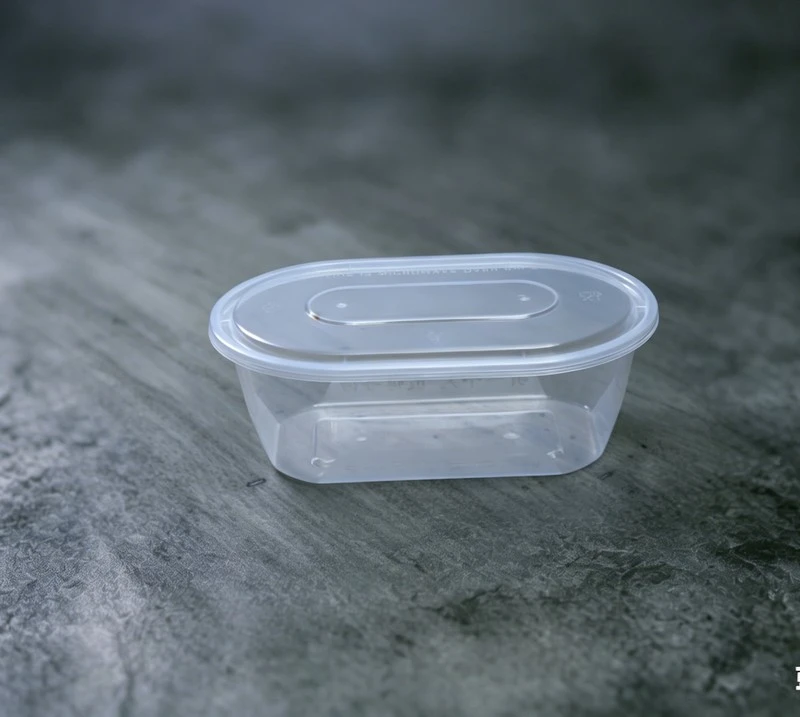
Imagine two containers holding the same 650 g meal: grilled salmon, roasted vegetables, and rice. The round container distributes the food toward the center, so the dish looks compact and deep. The oval container extends the food along a longer axis, making the salmon and vegetable arrangement easier to see from the front of a display case.
This is a visual effect created by geometry. An oval container generally has a higher length-to-width ratio than a round container. In a practical comparison, a 230 mm × 155 mm oval container has a length-to-width ratio of approximately 1.48, whereas a 180 mm round container has a ratio of 1.00. The oval provides roughly 28% more horizontal viewing span than a 180 mm round container, although the exact usable area depends on corner radius and wall thickness.
That additional span is useful when food has a directional shape. A chicken breast, fish fillet, wrap, baguette section, or sushi row can be positioned naturally rather than folded or stacked. Round containers remain stronger visually for curries, soups, rice bowls, fruit salads, and mixed meals where the food is meant to be viewed from the center.
Oval containers are usually more effective when the dish has a clear front-to-back arrangement. A caterer can place the main protein along the long axis and use vegetables or garnish as side accents. This improves product recognition because customers can identify the primary ingredient without opening the lid.
In a packaging trial reported by an independent meal-prep operator, an oval container reduced the need to stack sliced chicken by about one layer for a 500–600 g serving. The operator said the chicken remained more visible after transport, while the same portion in a round container looked deeper and less evenly distributed. The result was not that the oval held more food; it changed the presentation density and reduced visual obstruction.
Round containers have a different advantage: they create a consistent viewing angle. There is no obvious “front,” which is useful for self-service counters, family-style meals, sauces, and foods that customers scoop from multiple directions.
Round walls also avoid narrow end zones. In an oval container, the curved ends can become less accessible when the product is deep or when the spoon is wide. For soft foods such as oatmeal, yogurt, congee, and stew, this difference may be more important than the presentation benefit of a longer shape.
| Parameter | Oval Food Container | Round Food Container | Display and Use Implication |
|---|---|---|---|
| Visual shape | Extended length with rounded ends | Symmetrical circular profile | Oval emphasizes food arrangement; round emphasizes central fullness |
| Typical viewing angle | Best from the front or long side | Consistent from nearly every direction | Oval suits retail shelves; round suits shared counters |
| Long-food compatibility | High | Moderate to low | Oval is better for fillets, wraps, sliced meat, and vegetables |
| Soup and sauce performance | Good when depth and lid seal are sufficient | Usually excellent for centered liquid foods | Round often makes stirring and scooping easier |
| Portion visibility | High for separated food components | High for compact mixed meals | The best shape depends on whether the food is arranged or mixed |
| Stacking footprint | Can leave unused gaps in square cartons | Often creates corner gaps in rectangular cartons | Neither shape is automatically more space-efficient |
| Serving access | Easy along the long side; slightly less direct at the ends | Uniform access around the rim | Round works well for communal serving |
| Lid complexity | May require tighter mold control around curved ends | Generally simpler rotational symmetry | Check gasket compression and corner sealing rather than shape alone |
| Material consumption | Depends on wall height, rim, and corner radius | Depends on diameter and depth | Compare grams of material per usable liter, not only external size |
| Typical price position | Often slightly higher in custom or premium formats | Usually economical in standard sizes | Tooling, resin, lid design, and order volume influence actual cost |
For a fair technical comparison, buyers should calculate usable volume, not nominal volume alone. A simple estimate is length × width × average internal height, adjusted for rounded ends and the recommended fill line. A container labeled 750 ml may only provide 600–650 ml of practical food capacity if the product must remain below the lid to prevent compression and leakage.
Display is linked to food quality because the wrong shape can increase pressure, movement, and contact with the lid. A tightly packed sandwich may be visually attractive in an oval container but become compressed if the lid’s internal clearance is only 8–10 mm above the fill line. Conversely, a round container may leave more headspace around a compact meal but make long ingredients bend or overlap.
A reliable packaging process should leave a measured headspace. For non-carbonated hot foods, many operators begin testing with approximately 5–10% of container height available above the food, then adjust after checking steam, condensation, and transport movement. This is not a universal rule: soups, oily sauces, and foods that expand during heating require separate validation.
Thermal expansion also matters. If hot food is sealed immediately, trapped vapor can increase internal pressure and push against the lid. A container with a strong snap-fit may remain closed, but condensation can still reduce visual clarity. Transparent lids with a smooth inner surface generally show less distortion than heavily textured lids, although clarity depends on polymer grade, molding quality, thickness, and temperature exposure.
Round containers often make portion sizes look consistent because the eye reads the center first. This can help restaurants sell rice bowls, salads, soups, and mixed meals with standardized scoops. If a 500 g portion is placed in a round container with a 165 mm internal diameter, the food may appear deeper and more substantial than the same weight spread across a longer 220 mm oval base.
That perception can work both ways. A shallow oval meal may look abundant because more ingredients are visible, while a deep round meal may look smaller from above despite containing the same mass. Businesses should photograph both formats from the same camera height and lighting angle before changing packaging.
As the comparison moves from geometry to daily use, the answer becomes more practical. The following ranking focuses on display performance, serving convenience, and operational fit rather than declaring one shape universally superior.
For grilled meat, fish, kebabs, pasta portions, sliced vegetables, sushi, and layered side dishes, the oval format usually ranks first. It provides a longer arrangement line and makes separation between components easier to see.
An anonymized catering customer described a useful change after switching part of a buffet menu from round to oval containers: staff arranged the entrée along the centerline, placed vegetables at both ends, and reduced the amount of garnish used to make the food look complete. In the customer’s internal test, garnish consumption fell from approximately 12 g to 8 g per serving, a reduction of about 33%, because the base shape already looked more filled. This result depends on menu design and should be treated as a field observation, not a guaranteed saving.
Round containers rank first for liquid foods and meals that are stirred or eaten from multiple directions. The circular opening supports even spoon access and avoids pointed or narrow end zones.
They are also useful for delivery menus where the customer will remove the lid and eat directly from the package. A round bowl can provide a familiar eating experience, especially when food is served with broth, sauce, or toppings arranged around a central portion.
On a refrigerated shelf, similar rectangular and round packages can blend into one another. An oval profile can create a visual distinction without relying on bright labels or excessive graphics. This is valuable for premium meal kits, deli products, and ready-to-eat entrees.
However, shelf differentiation should not create logistics problems. Measure the case pack, carton dimensions, pallet pattern, and shelf depth before ordering. An oval footprint may display well but leave unused space in a square shipping carton. A 5% increase in empty carton volume can erase the perceived value of a more attractive package through higher freight and storage costs.
Shape alone does not determine price. The main cost drivers are resin type, container weight, lid weight, mold complexity, production volume, decoration, sealing method, and packaging configuration.
| Cost Factor | Potential Effect on Oval Containers | Potential Effect on Round Containers | What Buyers Should Request |
|---|---|---|---|
| Mold and tooling | May increase for custom curves and elongated geometry | Often lower for standard diameters | Ask for tooling cost, cavity count, and replacement terms |
| Material weight | Can be efficient if wall thickness is optimized | Can be efficient because circular walls distribute stress | Compare grams per container and usable volume |
| Lid design | May require a dedicated oval lid and stronger corner control | Often easier to standardize | Request leak-test and stacking-test results |
| Order quantity | Small custom orders may carry a higher unit price | Large standard runs are often more economical | Compare pricing at the actual monthly volume |
| Shipping efficiency | Could lose space in rectangular cartons | Could leave corner gaps in square cartons | Request carton dimensions and units per case |
For example, suppose an oval container costs $0.04 more per set but reduces garnish use by $0.03 and increases sell-through by 4% because the meal looks more visible. It may still be commercially attractive. On the other hand, if the oval format increases freight by $0.06 per unit and does not improve sales, the visual advantage may not justify the cost.
Zhengjia can be considered when a buyer needs a balance between presentation, dimensional consistency, and production scalability. The important step is to request samples and compare the complete set—container, lid, carton, and filled product—rather than evaluating an empty container on a catalog page.
Customer comments about oval and round containers tend to focus on four practical points: appearance after transport, ease of opening, leakage, and how much food appears visible through the lid.
One meal-prep customer, identified only as Lina in a packaging feedback record, compared two 700 ml containers for five weekday lunches. She preferred the oval version for chicken, vegetables, and noodles because the meal remained visually separated. She preferred the round version for curry and soup because the spoon reached the edge more easily. Her conclusion was practical: the business kept both shapes instead of forcing every menu item into one package.
That type of feedback is more useful than a simple five-star rating because it connects the shape to a specific meal. Buyers should look for reviews that mention container capacity, food type, transport time, temperature, lid behavior, and cleaning experience.
Start with the product, not the supplier. List the five foods that represent most of your sales and classify them as long, mixed, liquid, layered, or scoop-served. Then measure the longest ingredient, average portion mass, sauce volume, and required headspace.
A useful acceptance test is to place 10 filled units in a delivery carton, transport them over a route that reflects normal handling, and inspect the lids, corners, labels, and food arrangement. Record the number of leaks, displaced portions, cracked lids, and containers that cannot be stacked. This small sample will not replace formal quality assurance, but it exposes practical problems early.
The oval food container is best for businesses and households that want food to look arranged, visible, and presentation-ready. It is particularly suitable for grilled proteins, deli meals, catering portions, layered dishes, and retail products where front-facing appearance influences purchase decisions.
The round container is best for soups, sauces, curry, rice bowls, porridge, yogurt, mixed salads, and meals that require equal access from all sides. It is often the safer economical choice when standard sizes, simple stacking, and consistent portioning matter more than directional presentation.
Neither shape should be selected solely because it looks modern or costs less per unit. The correct choice depends on the food’s geometry, fill line, lid clearance, transport conditions, and complete supply-chain cost. For buyers comparing the best oval food container for display, an oval vs round food container system, or a food container for buffet presentation, the most reliable method is a filled-product trial that measures portion visibility, stacking efficiency, and seal integrity through actual dimensional tolerance and transport testing.
To make the next decision, prepare one representative meal, one liquid item, and one layered item; request oval and round samples from Zhengjia or other qualified suppliers; and compare them using the same food weight, camera angle, transport route, and price model. That process will show whether the extra display area of an oval container creates measurable value for your menu—or whether the balanced access and standard economics of a round container are the better fit.
Looking for a Reliable PP Food Container Manufacturer?
Request a Food Container Wholesale Quote Today! We would be happy to help!