
EN


 Aug.24, 2026
Choose a pp round container for soup by checking food-contact compliance, usable volume, lid sealing, temperature limits, microwave instructions, and transport performance—not by appearance alone. For a microwave-safe PP food container, confirm that the exact container-and-lid combination has been tested for heating. For a leak-proof PP noodle container, inspect the rim, gasket or snap-lock geometry, and run a filled-container leak test. The material should be identified as food-grade polypropylene, with relevant migration testing and, where hot filling is required, a validated hot-fill process.
Soup creates hydrostatic pressure and spill risk, rice needs sufficient headspace for expansion and reheating, and noodles require enough diameter to prevent clumping during filling and eating. A suitable PP round container must therefore match the recipe, filling temperature, delivery distance, reheating method, storage period, and washing or recycling policy. This guide explains how to make that choice, verify a supplier such as Zhengjia, and correct common failures before placing a production order.
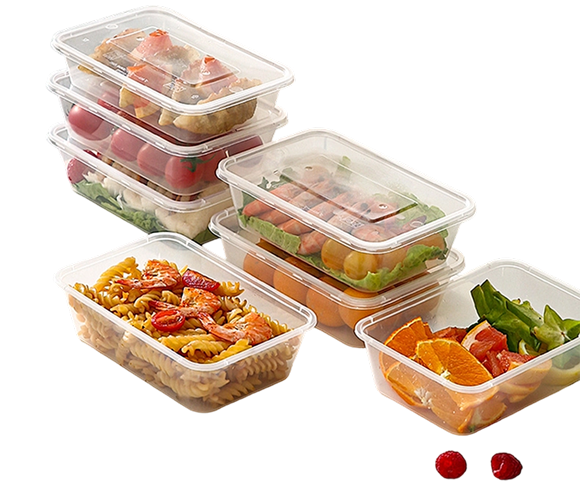
Soup is usually the most demanding application because it is liquid, often filled warm, and easily spilled when the container is tilted. A lid that closes securely when cold may loosen after thermal expansion or become difficult to open when the contents cool and create partial vacuum.
Rice and noodles require a different geometry. A narrow, deep container can hold volume efficiently but may make portioning, mixing, and microwave heating uneven. A wider round container generally gives better access and reduces the chance of noodles being compressed into a dense mass.
| Food application | Practical starting volume | What to verify |
|---|---|---|
| Small soup, side rice, snack portion | Approximately 350–500 mL | Actual fill weight, lid clearance, spill resistance |
| Single rice or noodle meal | Approximately 650–900 mL | Portion size, mixing space, microwave heating pattern |
| Large noodle meal or soup with toppings | Approximately 1,000–1,200 mL | Stacking stability, lid pressure, transport weight |
These are screening ranges, not universal serving rules. Confirm the volume using a calibrated scale and water-density calculation. At approximately 20°C, 1 gram of water is close to 1 millilitre, so a container holding 800 grams of water has a nominal water capacity near 800 mL. The usable food capacity should be lower than the brim capacity because a safe headspace is required.
Polypropylene, commonly abbreviated PP, is a thermoplastic polymer used in many food containers because it has low density—approximately 0.90 g/cm³—and a melting range commonly reported around 160–166°C for polypropylene grades. These figures describe the polymer, not a guaranteed operating temperature for a finished container. Wall thickness, additives, pigments, molding conditions, lid design, and food composition all affect performance.
Many containers use a polypropylene copolymer to improve impact performance, particularly at lower temperatures. Ask the manufacturer for the exact resin grade, technical data sheet, colorant information, and declaration of compliance. “PP” printed on the base is useful for identification, but it does not by itself prove suitability for hot soup, microwave use, or repeated washing.
Requirements depend on the market where the container will be sold or used. A purchasing specification should identify the applicable rules instead of accepting a general “food safe” statement.
Request the test report number, laboratory name, test conditions, food simulants, exposure time, temperature, and product identification. A report for one lid design, resin, or color should not automatically be treated as evidence for every product in a supplier’s catalogue.
Prepare the following information before requesting samples from Zhengjia or another manufacturer:
For a custom order, define acceptance criteria before tooling begins. Include dimensions, weight tolerance, color tolerance, lid closure force, leak performance, appearance limits, and the sampling plan. This prevents a dispute in which the supplier meets an undefined “good quality” expectation but the container still fails in the kitchen.
Tools: calibrated scale, graduated cylinder, thermometer, sample food, and worksheet.
Action: Prepare the soup, rice, or noodles using the normal production method. Weigh at least 10 representative portions, including the lowest and highest expected fill weights. Record both mass and temperature.
Parameters: Record target fill weight, maximum fill weight, food temperature at filling, and the amount of solid topping. For liquid-heavy products, also record the approximate volume.
Check: Select a container whose usable capacity leaves visible clearance above the food. As a starting point, test 10–15% headspace, then confirm it through transport and reheating trials. This range is a development guideline, not a regulatory limit.
Failure fix: If soup reaches the lid, move to the next larger size or reduce the portion. If rice appears undersized in a large container, choose a shorter, wider format rather than filling only a small area at the bottom.
Tools: product drawings, digital calipers, sample lids, and a filled sample set.
Action: Compare internal diameter, internal height, base diameter, rim width, and lid clearance. For noodles, place the actual noodle bundle into the sample rather than judging empty dimensions.
Parameters: Check whether chopsticks, forks, or ladles can reach the bottom. Confirm that toppings do not press against the lid. Measure the height of a filled stack and the available clearance inside the delivery bag.
Check: Shake a closed container gently in the same direction and duration expected during delivery. Inspect whether noodles become compressed, rice shifts to one side, or the lid contacts the food.
Failure fix: Select a wider opening for noodles and mixed rice meals. If stack stability is poor, use a container with a wider base, an anti-slip feature, or a compatible tray instead of relying on a tighter lid.
Tools: filled samples, room-temperature water, warm water, absorbent paper, and a timer.
Action: Fill the container to the defined test level, close the lid according to the supplier’s instructions, and wipe the exterior dry. Place it upright, then invert it over clean absorbent paper.
Parameters: Run an internal screening test for at least 30 minutes at room temperature and repeat with the product at its intended filling temperature after the container reaches a safe handling condition. Record lid closure condition and leakage mass.
Check: Look for droplets around the rim, hinge, vent, and lid corner. Weigh the container before and after the test if a quantitative leakage limit is required. Use a defined internal acceptance limit, such as “no visible leakage and no measurable loss above the validated method limit,” rather than the vague term “leak-proof.”
Failure fix: Confirm that the lid is matched to the container diameter and rim profile. Investigate warped rims, short snap hooks, insufficient sealing interference, flash, and contamination from oil or sauce. Do not solve a structural sealing defect by simply increasing closure force.
Tools: calibrated probe thermometer or data logger, heat-resistant gloves, sample containers, and a controlled heating area.
Action: Fill samples with the actual soup or rice product at the highest expected production temperature. Close them using the normal line procedure, then measure the food and exterior-wall temperatures at defined intervals.
Parameters: Record filling temperature, time to closure, cooling profile, lid deformation, base distortion, and handling temperature. Use the supplier’s validated temperature range; do not infer it from the PP resin melting range.
Check: Inspect the rim for warping, the base for rocking, and the lid for loss of engagement. Repeat the trial with the most acidic, oily, or salty recipe if that product represents the worst case.
Failure fix: If the container distorts, reduce the process temperature only when food-safety controls permit it, shorten the time before closure, change the wall or base design, or select a resin and product specifically validated for hot-fill service. A container that survives one hot sample is not automatically approved for every recipe.
Tools: the intended microwave model, calibrated temperature probe, sample containers, turntable, and written user instructions.
Action: Heat the actual food in the exact container-and-lid combination. Test the minimum and maximum fill quantities and include the food most likely to heat unevenly.
Parameters: Record microwave power, heating time, starting temperature, lid position, vent position, and food temperature at several locations. Follow the manufacturer’s instructions and do not seal a container during microwave heating unless the product has a designed venting method.
Check: Inspect for melting, cracking, lid displacement, excessive steam release, deformation, and hot spots. Check whether the container remains stable when removed.
Failure fix: Add a clear “vent lid” instruction, shorten heating intervals, stir between cycles, or remove the lid when required. If the container deforms, remove the microwave claim or redesign and retest. Microwave suitability must be established by testing the finished article, not by the letters “PP” alone.
Tools: filled samples, delivery bags, stack fixture, measuring scale, and camera.
Action: Stack containers at the maximum planned height and place them in the actual delivery packaging. Simulate the route with controlled movement, or use a qualified distribution test program.
Parameters: Record stack height, total load, transport duration, orientation, and temperature. For formal packaging qualification, ASTM D4169 can be considered as a distribution-testing framework, while ASTM D5276 is commonly used for free-fall drop testing; the selected distribution cycle and drop height must reflect the actual shipping system.
Check: After testing, inspect the lid seal, rim, base, labels, and container-to-container contact points. Measure leakage and count cracked or permanently deformed samples.
Failure fix: Reduce stack height, add a divider or tray, strengthen the rim, modify the lid locking points, or change the outer shipping carton. If only the lid fails, do not automatically increase container-wall thickness; the failure may be caused by lateral movement or poor load transfer.
Tools: digital calipers, scale, go/no-go gauges, color reference, light table, and inspection form.
Action: Approve a golden sample and compare production lots against it. Inspect dimensions, weight, appearance, lid fit, and functional performance.
Parameters: Define tolerances for diameter, height, wall thickness, product weight, flash, short shot, black specks, warpage, and color difference. Use a documented sampling plan such as ANSI/ASQ Z1.4 when appropriate, with the acceptable quality limit agreed before production.
Check: Confirm that each inspected sample can be traced to a production lot and resin batch. Perform periodic leak and closure tests rather than relying only on visual inspection.
Failure fix: Quarantine unidentified lots, separate cosmetic defects from functional defects, and require root-cause analysis for repeated warpage, lid mismatch, or weight drift. Corrective action may involve mold temperature, injection pressure, cooling time, material drying requirements where applicable, or assembly control.
The United States Department of Agriculture advises refrigerating perishable food within 2 hours, or within 1 hour when the surrounding temperature is above 90°F (32°C), and using refrigerated leftovers within 3–4 days. These are food-handling recommendations, not claims about the shelf life of a PP round container. The container must still be clean, compatible with the food, and kept at the required storage temperature.
This guidance creates a practical user case for meal-preparation operators: a chilled rice or noodle meal may need a container that tolerates filling, cooling, refrigeration, transport, and reheating within the same service cycle. The operator should record the actual cooling and reheating process, rather than assuming that a “reusable” label guarantees food safety.
For an evidence-based trial, the operator can test 10 containers containing the lowest and highest planned portions, record the food temperature at filling and refrigeration, inspect the lids after 24 and 72 hours, and conduct the documented reheating test. The result should be reported as measured pass or fail against pre-agreed criteria. It should not be presented as a personal success story unless the identity, test method, and records can be verified.
A nominal 750 mL label does not reveal usable capacity, headspace, lid clearance, or portion density.
Solution: Weigh the actual food, fill the sample, close the lid, and inspect the remaining clearance. Record both brim volume and recommended fill volume.
PP identification does not prove that the complete container, lid, pigment, label, or vent system has been validated for microwave heating.
Solution: Request finished-product instructions and test the exact food, power, time, lid position, and fill level used by customers.
Cold water does not reproduce hot soup viscosity, thermal distortion, steam pressure, oil contamination, or lid movement.
Solution: Use both water screening and actual-product testing at the worst-case fill temperature. Record visible leakage and mass loss.
A high-quality bowl with an incompatible lid can fail at the rim. Different molds may have small dimensional differences that prevent reliable engagement.
Solution: Approve the bowl and lid as one SKU combination, identify both parts, and reject mixed-lot or untraceable substitutions.
Overfilling reduces headspace, increases spill risk, and allows food to contact the lid during transport.
Solution: Establish a fill line by weight and train staff to use a calibrated portioning tool or scale. Recheck the fill line whenever the recipe changes.
A smooth surface can hide thin walls, incomplete lid engagement, weak hinges, or brittle parts caused by processing variation.
Solution: Combine visual inspection with dimensional measurement, weight checks, closure checks, leak testing, thermal testing, and distribution simulation.
Ask Zhengjia to quote the exact container volume, dimensions, resin grade, lid type, color, packing quantity, tooling status, and intended food-contact market. Request samples from production tooling when possible because hand-made or 3D-printed samples cannot reproduce injection-molded wall thickness, shrinkage, snap-fit behavior, or surface finish.
Compare suppliers using measurable fields:
| Evaluation area | Evidence to request | Acceptance question |
|---|---|---|
| Material | Resin grade and compliance declaration | Does it cover the intended food, temperature, and market? |
| Safety | Migration reports and test conditions | Was the exact product or an equivalent documented configuration tested? |
| Function | Leak, microwave, thermal, and drop-test records | Do the test conditions match actual use? |
| Consistency | Inspection plan and lot traceability | Can defects be linked to a resin batch, mold, or production date? |
| Implementation | Approved drawing, golden sample, and change-control process | Will the supplier notify you before changing resin, mold, or lid geometry? |
A reliable supplier relationship is built on traceable documents and repeatable tests. Claims such as “strong,” “premium,” or “fast delivery” should be converted into wall-thickness data, measured closure performance, agreed lead time, and inspection records.
For soup, prioritize lid sealing, thermal distortion resistance, adequate headspace, and upright transport. For rice, prioritize usable volume, a stable base, and enough surface area for even reheating. For noodles, prioritize a wide opening, topping clearance, fork or chopstick access, and a leak-proof PP noodle container design validated with sauce and movement.
Before approval, measure the portion, select the size, confirm the food-grade polypropylene grade, review migration testing, validate hot-fill conditions where relevant, and test the exact bowl-and-lid combination. Keep records of dimensions, weight, temperature, leakage, microwave behavior, stacking, and lot traceability. Whether you source from Zhengjia or another manufacturer, a PP round container for soup should earn its specification through documented performance, while a microwave-safe PP food container should carry heating instructions supported by testing rather than material assumptions.
We look forward toworking with you.
Feel free to reach out for any queries. We would be happy to help!

