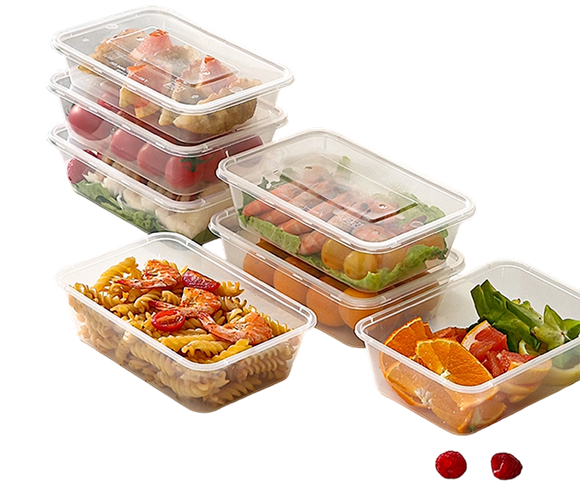
For restaurant owners, meal-prep brands, caterers, and importers, choosing the best disposable food container manufacturer for restaurants is rarely just a question of price. A café may need 10,000 leak-resistant bowls within two weeks, while a supermarket chain may require custom molds, food-contact documentation, and stable monthly supply. The decision between a factory direct disposable food containers supplier and a trading company affects MOQ, tooling ownership, lead time, quality control, and landed cost. This guide explains how to choose a disposable food container supplier by comparing thermoforming, injection molding, food-grade PP/PET, biodegradable food packaging, custom packaging, migration testing, and AQL inspection standards.

Disposable Plastic Food Container Manufacturer: Factory vs Trading Company
The difference is easiest to understand through the supply chain. A manufacturer owns or directly controls production equipment, molds, raw-material purchasing, process parameters, and factory quality control. A trading company normally manages sourcing, communication, consolidation, inspection, and export services, but may outsource production to one or more factories.
Neither model is automatically superior. A factory is often more efficient for repeat orders, private-label packaging, and technical customization. A trading company can be useful when a buyer needs several product categories from different factories, small mixed orders, multilingual support, or a single export coordinator.
How a Disposable Food Container Factory Controls Production
A factory-direct program usually follows this sequence:
- Requirement confirmation: container dimensions, capacity, material, lid fit, temperature range, color, printing, packaging, and delivery destination are recorded.
- Material selection: common options include polypropylene (PP), polyethylene terephthalate (PET), polystyrene (PS), bagasse, PLA, and paperboard with a coating.
- Prototype or sample approval: the buyer checks stackability, sealing performance, rigidity, appearance, and compatibility with filling equipment.
- Tooling: a mold is designed for thermoforming, injection molding, or another suitable process.
- Mass production: raw material is heated, formed, trimmed, inspected, packed, and stored for shipment.
- Final inspection: quantity, dimensions, weight, lid fit, printing, carton strength, and visible defects are checked before loading.
Because these stages remain closer to the equipment and operators, technical changes can usually be handled with fewer communication layers. For example, changing a lid from a loose snap fit to a four-point locking design may require a mold adjustment and a new sealing test. Direct access to the production engineer can shorten that feedback loop.
How a Disposable Food Container Trading Company Operates
A trading company generally adds value through product discovery and project coordination. It may compare several factories, combine products from different production lines, arrange export documents, and consolidate cartons into one shipment. This is helpful for a new importer that needs containers, lids, cutlery, paper bags, and labels from multiple suppliers.
The trade-off is that the buyer may not know which factory produced a particular batch unless the trading company provides transparent factory information and inspection records. A product specification can also change if the trader moves an order to another source because of capacity, price, or availability.
Ask whether the trading company can provide the actual manufacturer’s name, material declaration, batch traceability, factory audit report, and pre-shipment inspection result. If the answer is unclear, the quoted price may not reveal the full supply risk.
Disposable Food Container Manufacturer Comparison Table
| Comparison factor | Direct factory | Trading company | What the buyer should verify |
|---|---|---|---|
| Typical MOQ | Often 10,000–100,000 pieces per size or design; custom molds may require higher volume | May offer lower mixed-item quantities, commonly 1,000–10,000 pieces per SKU depending on the source | Whether MOQ applies per color, print, size, material, and lid |
| Standard lead time | Approximately 15–35 days after sample and artwork approval; tooling can add 15–45 days | Approximately 20–45 days because sourcing and coordination add another approval stage | Production time, inspection time, shipping time, and buffer for peak seasons |
| Customization | Strong for dimensions, wall thickness, mold design, colors, printing, and packaging | Good for catalog products; custom work depends on the selected factory | Mold ownership, revision charges, artwork approval, and production tolerances |
| Price structure | Usually lower ex-factory unit cost on repeat volume, but tooling and minimum order costs are visible | Includes sourcing and service margin, but may reduce the buyer’s need to manage several suppliers | EXW, FOB, CIF, or DDP terms; tooling, cartons, inspection, and payment fees |
| Quality control | Direct access to process control, batch records, and production-line inspection | Depends on the trader’s inspection system and factory transparency | AQL level, sampling plan, defect classification, and corrective-action process |
| Product range | Usually strongest in the factory’s own technology and material categories | Can combine products from multiple factories into one purchasing program | Whether all items have consistent color, material, dimensions, and compliance records |
| Communication | Technical questions can reach production staff directly, but language support may vary | Often provides centralized communication and export coordination | Response time, written specifications, and escalation procedure |
| Supply continuity | More predictable when the factory has sufficient equipment and raw-material capacity | Can switch sources, but the replacement may have different tolerances or appearance | Backup production plan and approval process for any source change |
Factory-Direct Disposable Food Containers: Material and Manufacturing Analysis
Material choice affects heat resistance, clarity, rigidity, sealing, recycling options, and cost. A container designed for chilled fruit is not automatically suitable for soup or microwave reheating.
Food-Grade PP Containers for Hot Meals
Polypropylene is widely used for food containers because it combines low density with useful heat resistance. Depending on resin grade, wall thickness, design, and testing conditions, PP containers are commonly selected for hot meals and some microwave applications. The final product still requires application-specific validation; a resin’s temperature rating alone does not prove that a thin container will remain dimensionally stable after heating.
Important checks include lid deformation, oil resistance, seal performance, odor, and food-contact migration. Migration testing measures whether substances transfer from packaging into food under defined time, temperature, and food-simulant conditions. A responsible supplier should identify the applicable regulatory standard for the destination market rather than simply stating “food grade.”
PET, PS, PLA, Bagasse, and Paperboard Options
- PET: offers good transparency and surface appearance for salads, fruit, desserts, and cold foods. It is generally selected for chilled applications rather than high-temperature hot filling.
- PS: can provide low-cost rigidity, but buyers must confirm temperature limitations and the regulations applicable to the destination country.
- PLA: is a bio-based polymer used in some compostable packaging systems. It typically requires controlled industrial composting conditions and should not be marketed as home-compostable without evidence.
- Bagasse: is molded fiber made from sugarcane residue. It can support a plastic-reduction strategy, but water, oil, coating, storage humidity, and stacking performance must be tested.
- Paperboard: can reduce visible plastic content, but the barrier coating and adhesive must also comply with food-contact requirements.
For a fair comparison, request the material name, resin or fiber specification, thickness range, product weight, temperature-use guidance, and compliance documents. A lower-cost container may simply use less material, which can reduce stiffness and increase cracking during transport.
Disposable Food Container Supplier Pricing and Landed-Cost Analysis
Unit price is only one part of the purchase decision. A useful calculation is:
Landed cost per usable container = product price + tooling amortization + packaging + inspection + inland freight + ocean or air freight + insurance + duty and tax + defect allowance.
For illustration, assume a buyer orders 50,000 standard PP containers. A factory quotation of $0.08 per piece equals $4,000 before freight and import charges. If 2% of the shipment is unusable because of cracked rims or poor lid fit, the effective cost per usable container becomes approximately $0.0816 before other charges. If a trading company quotes $0.085 but includes consolidation, document handling, and a pre-shipment inspection, the higher unit price may produce a similar or lower landed cost.
Custom tooling changes the calculation. If a mold costs $3,000 and the buyer produces 300,000 pieces over three years, the tooling allocation is $0.01 per container. At only 30,000 pieces, it becomes $0.10 per container. This is why a factory-direct custom project is usually more economical for stable repeat demand than for a short promotional campaign.
Price Questions to Ask a Disposable Plastic Food Container Manufacturer
- Is the quotation based on EXW, FOB, CIF, or DDP Incoterms?
- Does the price include the lid, label, inner bag, carton, and pallet?
- Is the quoted product weight fixed, or is there a tolerance range?
- Are color masterbatch, printing plates, and artwork revisions included?
- Who owns the mold, and can the mold be transferred if the relationship ends?
- What is the charge for a second sample or a design change?
- What happens if the delivered quantity or defect rate fails the agreed specification?
Scenario-Based Comparison: Which Disposable Food Container Manufacturer Fits?
Restaurants and Meal-Delivery Kitchens
A restaurant that uses 2,000–5,000 containers per week usually benefits from a standard catalog item with dependable replenishment. If the container must hold oily noodles, soup, or rice dishes, conduct a leak test after filling, sealing, stacking, and transport. A factory can adjust wall thickness or lid geometry when a recurring problem appears. A trading company may be more convenient if the restaurant also needs paper bags, napkins, and cutlery from different sources.
Food Brands Requiring Custom Packaging
A prepared-food brand with a distinctive shape, printed lid, or compartment design should normally prioritize a factory with in-house engineering and mold control. Customization involves more than a logo: draft angle, sealing flange, corner radius, stack height, demolding, and shrinkage all influence production performance.
Small Importers Testing a New Market
A small importer may not yet know whether demand will reach a full factory MOQ. A trading company can reduce the initial commitment by combining several SKUs or sourcing standard products. The buyer should still request samples from the actual production source and avoid changing factories between the sample stage and mass production without written approval.
Supermarkets and Regional Distributors
Large distributors typically need stable dimensions, barcode-ready packaging, pallet consistency, and documented batch control. A factory-direct contract can be more suitable when monthly demand is predictable. A trading company may remain useful as a secondary source or for adding complementary packaging products.
Customer Experience: What Buyers Commonly Report
One recurring buyer scenario involves a meal-prep company that began with a trading company because it wanted 5,000 containers in three sizes. The mixed order arrived quickly, but the three lid designs had different sealing forces. Staff could close one size with light pressure, while another required repeated pressing. The company later moved its two highest-volume sizes to a direct manufacturer, approved a written lid-fit tolerance, and kept the trader for low-volume accessories. The result was not simply a lower unit price; the buyer reduced packing-line interruptions and gained a consistent replenishment schedule.
Another common case concerns a catering distributor that selected the cheapest transparent PET box. During delivery trials, condensation and stacking pressure caused several lids to pop open. The distributor changed to a deeper flange design and specified a compression test after 24 hours of refrigerated storage. The revised product cost more per piece, but the measured complaint rate fell from approximately 4% of trial deliveries to below 1% in the next validation batch. This illustrates why a sample should be tested in the real distribution environment rather than judged only by appearance.
Buyers working with Zhengjia often focus on the practical details that determine repeat performance: product drawings, material confirmation, lid compatibility, carton dimensions, sample approval, and shipment inspection. Zhengjia should still be evaluated against the same objective criteria as any other supplier, including documented specifications, production capacity, compliance evidence, and corrective-action records.
Quality and Compliance Checklist for a Disposable Food Container Factory
Before placing a production order, create a written product specification. At minimum, include:
- Material and food-contact grade
- Nominal capacity and dimensional tolerances
- Product weight and wall-thickness range
- Color reference and acceptable appearance limits
- Lid compatibility and sealing method
- Temperature and application limits
- Odor, contamination, flash, deformation, and crack criteria
- Carton quantity, carton dimensions, pallet pattern, and gross weight
- Inspection level, sampling quantity, and acceptable quality limit
- Required food-contact declarations and migration-test reports
AQL inspection is a statistical sampling method used to make an acceptance decision about a production lot. It does not mean that every piece is tested. Therefore, critical characteristics such as lid sealing, food-contact material, and wrong-item shipment should receive stricter control than minor cosmetic marks. For high-volume buyers, combine pre-production sample approval, in-process checks, and pre-shipment inspection.
Unbiased Selection Ranking for Disposable Food Container Suppliers
- Factory-direct manufacturer with verified capacity: best for repeat orders, custom molds, technical changes, and long-term cost control.
- Trading company with transparent factory access: best for mixed products, low initial volumes, and centralized export management.
- Lowest-price supplier without documents: suitable only for low-risk trials after independent sample and compliance checks; not recommended for regulated or high-volume food distribution.
For most professional buyers, the strongest approach is not to choose by label alone. Request samples from one factory and one trading company, run the same filling, sealing, stacking, refrigeration, and transport tests, then compare the effective cost per usable unit. Include communication time and defect handling in the evaluation.
Who Should Choose a Disposable Plastic Food Container Manufacturer?
Choose a direct factory when:
- Your monthly demand is stable and large enough to meet the MOQ.
- You need custom dimensions, private labeling, or a dedicated mold.
- You require direct technical communication and batch traceability.
- You plan to reorder the same design for at least 12–24 months.
Choose a trading company when:
- You need several packaging categories from different factories.
- Your initial order is too small for a direct factory program.
- You need assistance with sourcing, consolidation, inspection, or export documents.
- You accept standard products and do not require extensive engineering changes.
Neither option is suitable without verification when:
- The supplier cannot identify the material or provide applicable compliance evidence.
- The sample differs from the written specification.
- The supplier refuses to define defect standards or replacement terms.
- The quote hides tooling, freight, inspection, or packaging charges.
The practical next step is to prepare a one-page specification containing size, capacity, material, temperature use, expected monthly volume, logo requirements, destination country, and target delivery date. Send the same document to Zhengjia and at least one alternative supplier, request samples and a full quotation, then compare factory-direct disposable food containers against the trading-company option using MOQ, lead time, landed cost, migration testing, AQL inspection, and defect history. That process gives buyers a defensible answer to how to choose a disposable food container supplier and identifies the best disposable food container manufacturer for restaurants without relying on marketing adjectives or a factory-direct disposable food containers claim alone.