EN


 Jun.03, 2026
Is an Industry Turning Point Arriving? Going Beyond "Just Filling It" to "Eating Well"
In 2026, the global food packaging market is undergoing profound cyclical changes. Industry data shows that the global online food delivery container market is projected to reach tens of billions of dollars in 2026, maintaining a compound annual growth rate (CAGR) of approximately 7.6% until 2033. However, simple scale growth is no longer the sole source of industry dividends.
Against this backdrop, PP (Polypropylene) as the "king material" in food packaging, is experiencing a qualitative shift in its market logic. It is moving from simply relying on "compliance dividends" (meeting food-grade standards) into the deep waters of "technical differentiation and scenario customization."
For companies focusing on PP injection-molded lunch boxes, especially the multi-compartment American-Style Series, 2026 marks both the end of low-end involution and a golden window to enter the high-margin supply chain through hard-core strength.

Deep Dive: Are Three Major Trends Reshaping the PP Lunch Box Market?
1. A Shift in Fundamental Logic: Is Food Grade Just the Starting Line, While Functionality Becomes the Moat?
In the past, many buyers only focused on the "PP" material name. However, industry insights for 2026 reveal that food-grade polypropylene (meeting FDA, GB 4806, EU No 10/2011) has become entry-level standard, no longer offering differentiated premium capabilities.
The real competitive focus is shifting towards the extreme optimization of application performance:
Confronting the Dual Challenge of Heat and Oil: With the popularity of American-style cuisine (like BBQ, hot sauces, fried foods) and prepared meals (frozen/reheating), the market is imposing strict demands for low-temperature resistance (-20°C freeze-proof) and high-temperature resistance (125°C oil resistance).
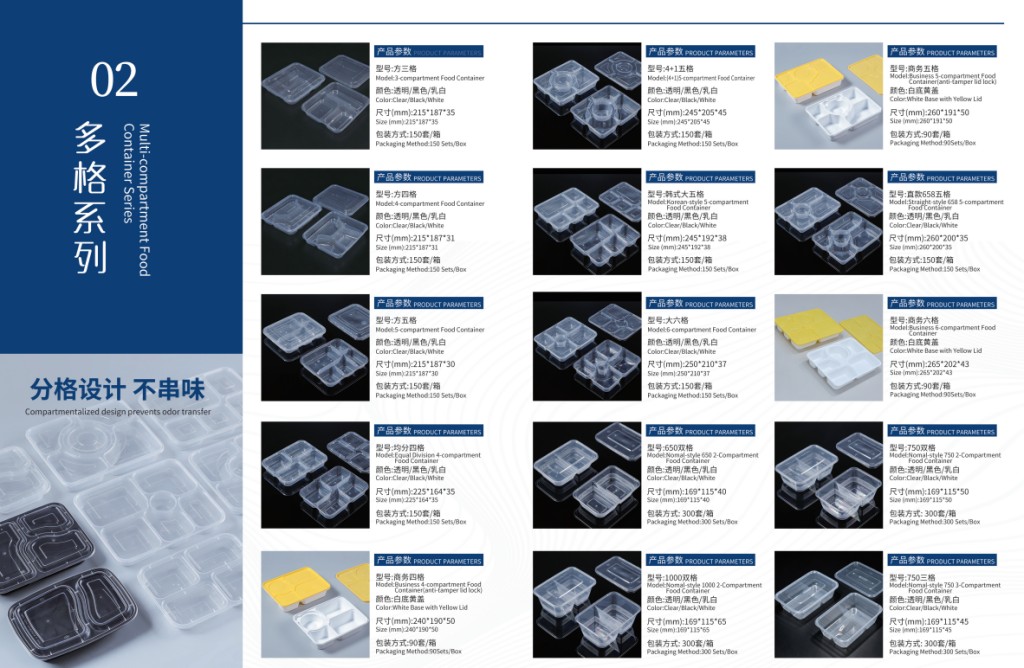
Focusing on Structural Design: Standard bowls or single-compartment rectangular boxes can no longer meet complex dining scenarios. The Multi-Compartment American-Style Series is becoming a growth leader. Its core value lies in achieving "dry-wet separation" and "rice-dish separation" through physical compartments, preventing flavor mixing and maintaining the premium presentation of high-end catering.
2. The Burst of Market Segmentation: Is the "Large Capacity" & "Rigidity" Demand Driven by American-Style Dining?
From an application perspective, the recovery of North American and European markets is driving the consumption upgrade of "premium disposable tableware." Compared to the Asian market's preference for lightweight options, the American-Style Series emphasizes a sense of "heft" and "stiffness."
Latest industry research points to booming demand for high-barrier, microwaveable, and puncture-resistant packaging. This means the advantages of the injection molding process over thermoforming are being amplified:
Injection-Molded Products: Offering uniform wall thickness, high rigidity, excellent stackability, and smooth, burr-free edges – perfectly matching the North American market's discerning eye for "quality feel."
Multi-Compartment Design: Utilizing precision mold technology to physically isolate rice, main courses, side dishes, and sauces, meeting the standardized meal prep needs of American-style fast food.
3. Reconstructing the Supply Chain: Is the "Manufacturer-Trader Integration" Model Ending Middleman Markups?
Facing fluctuations in raw material (PP pellet) prices, the room for survival of pure trading companies is being extremely compressed. This is precisely where the opportunity lies for integrated manufacturers and traders.
Source factories with the following advantages will win in this reshuffle:
Achieving Cost Control: Directly sourcing raw materials and hedging against price volatility through large-scale procurement.
Enabling Customized Quick Response: The mold development cycle for American-style lunch boxes is long and requires high precision. Factories with in-house mold workshops can quickly modify designs (e.g., enhancing the seal of the snap closure, adjusting compartment depth) based on customer needs – an agility pure traders cannot match.
Purchasing Decisions in 2026: Is the Shift from "Buying a Product" to "Buying a Service"?
For overseas importers and large restaurant chains, they are no longer just looking for "factories that can produce PP boxes." They are seeking "one-stop packaging solution providers."
The Rising Consideration of Environmental Closed-Loop Capabilities:
Although PP is 100% recyclable, under the pressure of the "dual carbon" policies in Europe and the US, companies unable to provide technical explanations regarding lightweighting (achieving the same strength with fewer raw materials) or recyclability will find it hard to access premium retail channels.
Focusing on Visual Differentiation (Branding):
A lunch box is not just a container; it is a brand vehicle. The clear lid design, anti-fog treatment, and custom printing of the Multi-Compartment American-Style Series are becoming key factors for brand premium in the chain restaurant industry.
Conclusion
At this critical industry turning point where one must advance or retreat, the PP injection-molded lunch box industry is moving away from unchecked growth.
For enterprises possessing the integrated manufacturer-trader DNA and focusing on the Multi-Compartment American-Style Series, 2026 should not be about falling back into the death cycle of "price cuts leading to quality cuts." Instead, they should seize the industry trend of "Food-Grade + High Performance + Strong Customization." By demonstrating superior mold technology, a strict safety compliance system, and a stable supply chain, we are not just manufacturers of plastic boxes; we are becoming the trusted partner for global food service giants.
Follow our news updates for in-depth analysis of the PP lunch box industry and practical foreign trade insights.
We look forward toworking with you.
Feel free to reach out for any queries. We would be happy to help!