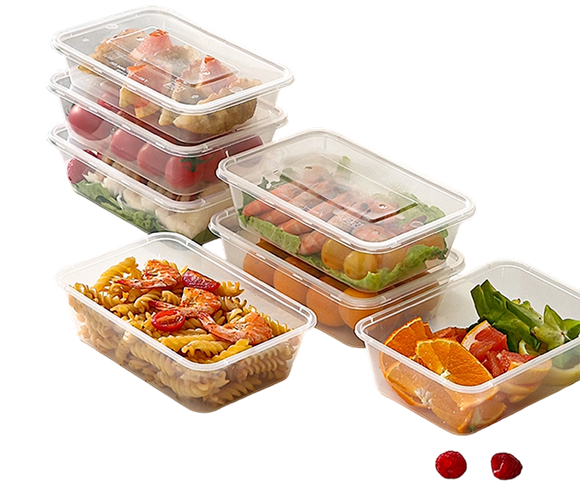
Restaurant groups, meal-prep brands, caterers, and food distributors sourcing bulk American-style food containers need more than a low unit price. They must compare wholesale disposable food containers for takeout, leak-proof meal prep containers wholesale, and formats such as PP food containers, deli containers, and hinged clamshells against food-contact compliance, migration testing, and thermoforming performance. This guide explains how to select, test, cost, and reorder containers that fit American portions, transport conditions, filling equipment, and customer expectations.

Why American-Style Plastic Food Container Wholesale Requires More Than a Catalog Choice
A container that looks suitable in a product photograph can fail after it is filled with hot pasta, stacked in a delivery bag, refrigerated overnight, or reheated by a customer. Buyers often face four connected problems: the lid leaks during delivery, the base deforms under heat, the selected size does not match the actual serving, or the carton occupies too much warehouse space.
American foodservice operations also use a broad volume range. A side dish may require 8–12 fl oz, a standard entrée often fits 24–32 fl oz, and a family meal may need 48–64 fl oz or more. A difference of only 2 fl oz can affect fill appearance, sauce headspace, shipping weight, and the customer’s perception of value. For this reason, the best wholesale program begins with the application rather than the container name.
For example, a delivery kitchen selling 28 oz rice bowls needs a container with enough freeboard to prevent sauce contact with the lid. A bakery shipping chilled desserts needs clarity, stackability, and condensation control. A supermarket deli may prioritize tamper evidence and barcode labeling. These are different packaging briefs, even when all three buyers ask for “food containers.”
American-Style Food Container Wholesale Terminology and Material Principles
PP Food Containers for Heat Resistance and Reheating
Polypropylene, commonly identified as PP, is widely used for hot food and meal-preparation containers because its softening behavior is more suitable for many foodservice heating applications than polystyrene. A typical PP food container may tolerate a broad working range, often approximately -20°C to 120°C, but the exact limit depends on resin grade, wall thickness, additives, geometry, and lid construction.
PP is also relatively light. If a 32 oz container weighs 28 g and a comparable heavy-wall design weighs 36 g, a shipment of 100,000 pieces contains a 800 kg difference in plastic weight. That affects freight, storage, and the customer’s sustainability calculation. Lower weight is not automatically better, however. A thinner wall can increase buckling, corner cracking, and lid separation during stacking.
PET and rPET Containers for Clarity and Cold Food
Polyethylene terephthalate, or PET, provides high transparency and a glossy appearance that works well for salads, fruit, bakery products, and chilled deli foods. PET containers are generally selected for cold applications rather than high-temperature microwave use. Recycled PET, known as rPET, can support recycled-content targets, but the buyer should confirm the percentage, color consistency, food-contact status, and supply stability for every production batch.
Hinged Clamshells, Two-Piece Deli Containers, and Tamper Features
A hinged clamshell integrates the lid and base, reducing the risk of mismatched components and simplifying packing-line handling. A two-piece deli container usually offers a separate lid and base, which can improve nesting efficiency and allow the same lid to fit several base sizes. The decision depends on labor, storage, display presentation, and security requirements.
For delivery and retail, buyers may request tamper-evident bands, breakaway tabs, or perimeter locks. These features should be tested after filling because a closure that works empty may become difficult to close when the container is filled to 90% of its nominal volume.
Food-Contact Compliance and Migration Testing
Food-contact compliance means that the finished article, not only the raw resin, is suitable for its intended food and temperature conditions. Buyers should request documentation covering the material composition, applicable food-contact regulations, restricted substances, and test conditions. Migration testing evaluates whether substances transfer from the packaging into food simulants under defined time and temperature exposure.
A practical specification may include contact with aqueous, acidic, alcoholic, and fatty foods, plus a stated maximum temperature and duration. A container intended for hot soup should not be marketed as suitable for oven use unless the manufacturer has validated that application. “BPA-free” is also narrower than full food-contact compliance; it does not by itself confirm performance, migration limits, or suitability for microwave reheating.
How to Select American-Style Plastic Food Containers Wholesale
The most reliable purchasing process converts a food operation into measurable packaging requirements. The following sequence helps prevent a low-cost order from becoming an expensive replacement project.
Step 1: Define the Food, Temperature, and Distribution Route
1. List the food categories: oily entrées, acidic sauces, frozen meals, fresh produce, bakery items, or dry snacks. Fatty foods can interact differently with packaging materials than water-based foods, while acidic foods may require specific compliance testing.
2. Record the filling temperature, storage temperature, and reheating method. For example, a kitchen may fill soup at 85°C, refrigerate it at 4°C, and deliver it within 24 hours. That profile is more useful than simply writing “hot food.”
3. Map the route from filling line to customer. Note whether containers are hand-carried, placed in insulated bags, stacked in a truck, or displayed under refrigeration. A delivery route with five stacked layers creates a different compression requirement from a single-layer retail display.
Step 2: Convert Serving Size into Usable Capacity
1. Separate nominal volume from usable fill volume. A container labeled 32 oz may not be suitable for 32 oz of liquid food if the product needs headspace. For soups, sauces, and foods that expand during heating, a 10–15% headspace allowance is often a practical starting point, subject to product testing.
2. Measure the actual portion with a calibrated scale or graduated vessel. Water density is close to 1 g/ml, but rice, pasta, meat, and mixed foods have different bulk densities. A 500 g meal does not necessarily occupy the same volume as 500 ml of water.
3. Check internal dimensions, not only the printed ounce value. A broad, shallow 32 oz container may present a better meal appearance and cool faster than a narrow, deep container. A deeper shape may reduce lid contact but can create problems for automated filling or utensil access.
Step 3: Match the Material to the Application
1. Select PP when hot filling, microwave reheating, or freezer-to-reheat use is central to the application and the specific product has been validated for those conditions.
2. Select PET when product visibility, cold display, and a rigid premium appearance matter more than heat resistance.
3. Consider bagasse, paperboard, or other fiber-based formats when compostability or renewable-content claims are commercially important. These materials have different moisture, grease, sealing, and storage requirements, so they should not be treated as direct substitutes for plastic.
Step 4: Check Lid Compatibility and Leak Resistance
1. Confirm whether the lid uses a snap lock, friction fit, perimeter channel, hinge lock, or film seal. The closure type should match the food’s viscosity and the expected handling speed.
2. Conduct a liquid leak test. Fill the container to the intended level, close it according to the production method, turn it upside down for 30 seconds, and then place it on its side for 5 minutes. Repeat the test after refrigeration and after reheating if those conditions apply.
3. Test filled containers after a realistic vibration cycle. A simple internal screening method is to place sealed samples in a shipping carton, move the carton over a rough surface for 15–30 minutes, and inspect for lid release, cracks, and sauce leakage. Formal distribution testing can be performed under ISTA or ASTM packaging procedures when the shipment value justifies it.
Step 5: Evaluate Stacking, Nesting, and Carton Efficiency
1. Measure the empty nesting height. If 100 bases occupy 420 mm when nested and a competing design occupies 520 mm, the first design saves 100 mm per stack, or approximately 19.2% of stack height before pallet optimization.
2. Check filled stack compression. Place the planned number of containers in a stack and apply a load equivalent to the upper cartons. Inspect the lowest unit for sidewall collapse, lid deformation, and loss of seal.
3. Calculate carton utilization. A container may have a lower unit price but produce more air per carton, increasing freight cost. Compare pieces per carton, gross carton weight, carton dimensions, pallets per 40-foot container, and estimated landed cost rather than comparing factory price alone.
Step 6: Request Samples and Build a Test Record
1. Request samples from the intended production mold and material grade whenever possible. A showroom sample from a different tool may not represent the final wall thickness, gate position, color, or lid tolerance.
2. Test at least three production conditions: empty handling, filled handling, and post-storage handling. Record closure force, leak results, stacking behavior, appearance, and dimensional changes.
3. Use a sample size large enough to reveal variation. Testing 10 pieces can identify obvious defects, while 30–50 pieces provides a more useful first view of closure consistency. For critical packaging, buyers may define an acceptable quality limit and require statistical inspection at incoming quality control.
Step 7: Compare Wholesale Pricing as Total Landed Cost
1. Add the unit price, tooling cost, printing or labeling cost, inner packing, export cartons, freight, insurance, duties, and domestic delivery.
2. Include operational costs. A lid that takes two seconds longer to close can add more labor than a small price difference. At 3,000 units per hour, an additional two seconds per unit reduces theoretical throughput by approximately 600 units per hour.
3. Estimate waste. If a 1.5% defect rate affects an order of 200,000 containers, 3,000 pieces may require replacement. A supplier with a slightly higher quoted price but a documented inspection process may deliver a lower cost per usable container.
American-Style Food Container Wholesale Case: Choosing a 32 oz Meal Container
Consider a meal-prep company selling chilled and reheatable rice bowls. Its target fill is 750 g, the product contains sauce, the customer reheats the meal in a microwave, and deliveries may remain in an insulated bag for 90 minutes.
The buyer first compares two PP containers. Design A weighs 30 g, measures 220 × 170 × 50 mm, and uses a four-point snap lid. Design B weighs 36 g, measures 205 × 165 × 58 mm, and uses a perimeter channel lid. Design A provides a wider presentation area and lower material consumption. Design B offers greater depth and may reduce sauce movement during transport.
After filling both designs to 750 g, the buyer checks headspace, lid closure force, microwave deformation, and leakage after 90 minutes in an insulated bag. If Design A leaks during side storage while Design B remains sealed, the additional 6 g of plastic must be compared with the cost of customer refunds, replacement meals, and brand damage.
The final choice should be based on measured performance. A suitable record might show: 0 leaks in 50 samples, no visible lid deformation after three reheating cycles, less than 2 mm dimensional change after hot filling, and a closure force that warehouse staff can apply consistently. Those figures create a purchasing standard that can be checked on future lots.
Advanced Buying Skills for American-Style Plastic Food Container Wholesale
Use a Specification Sheet Before Negotiating the Price
A professional specification sheet should include product code, nominal and usable volume, top and bottom dimensions, height, material, color, weight tolerance, lid compatibility, temperature limits, packaging quantity, carton dimensions, pallet configuration, and intended food application. It should also state whether the container is microwaveable, freezer-compatible, recyclable, or suitable for hot filling. Each claim should be supported by the manufacturer’s technical information or test data.
Control Color, Clarity, and Recycled Content
Color variation can result from pigment concentration, recycled resin, processing temperature, or mixing time. For branded foodservice packaging, request an approved color standard and define an acceptable visual range. For clear PET, specify haze or clarity expectations when product visibility affects sales. If recycled content is required, define the minimum percentage and the evidence needed for verification.
Plan Tooling and Mold Maintenance
Custom american-style plastic food container wholesale projects may require a new mold for a specific footprint, volume, hinge, or sealing profile. Before approving tooling, clarify ownership, maintenance responsibility, expected mold life, spare parts, and revision control. A mold change can alter wall thickness, nesting height, lid fit, and carton quantity, so the buyer should require a new sample approval after any engineering modification.
Set Incoming Quality Control Rules
Incoming inspection can cover dimensions, weight, visual defects, lid fit, carton count, color, and contamination. A practical sampling plan may inspect 30–80 pieces per lot depending on order size and risk, with tighter controls for critical defects such as sharp edges, foreign material, incomplete seals, or cracked hinges. Keep retained samples from each approved lot so future complaints can be compared against the original production condition.
Improve Sustainability Without Sacrificing Function
Material reduction should be validated through performance testing. Reducing container weight from 34 g to 30 g saves approximately 11.8% of plastic, but only if the container still passes stacking, drop, leak, and heat tests. Buyers should also evaluate whether the design is compatible with local recycling systems. A recyclable resin does not guarantee that the finished package will be collected or recycled in every market.
How Zhengjia Can Support a Wholesale Container Program
Zhengjia can be considered when a buyer needs American-style food container formats, custom sizes, coordinated lids, private-label packaging, or repeat wholesale supply. The project should begin with the food type, temperature profile, target volume, delivery route, and expected annual quantity. From there, the supplier can recommend a standard mold or discuss a custom design, provide samples, confirm material documentation, and coordinate production and carton specifications.
Before placing a large order, ask for a written quotation that separates tooling, product, packing, and logistics costs. Confirm the minimum order quantity, production lead time, sample approval process, inspection standard, replacement policy, and documentation package. This approach makes the supplier relationship measurable instead of relying on general claims such as “strong,” “premium,” or “leak-proof.”
Conclusion: A Lower-Risk Route to American-Style Food Container Wholesale
The right wholesale container is the one that performs under the customer’s actual conditions: the correct usable capacity, stable material behavior, secure lid, efficient carton, documented food-contact compliance, and repeatable quality. Buyers should compare PP food containers, PET deli containers, and hinged clamshells through samples, fill tests, heat tests, leakage checks, stacking trials, and landed-cost calculations. When you are sourcing bulk American-style food containers, wholesale disposable food containers for takeout, or leak-proof meal prep containers wholesale, Zhengjia can help assess the specification and develop a practical supply plan based on thermoforming, migration testing, and food-contact compliance requirements.